Showing posts with label Pershing Square. Show all posts

Thursday, May 27, 2010

Latest Ideas From Some Heavy Hitters

By Eric Jackson
RealMoney Contributor

5/27/2010 5:00 PM EDT
Click here for more stories by Eric Jackson


Yesterday was the 15th annual Ira Sohn Research Conference in New York. The event brings together the best hedge-fund managers in the world to present their top ideas for the coming year. All proceeds from the event go to charity, supporting pediatric cancer and other childhood diseases.

The event has a stellar reputation, partly because of its track record of managers presenting ideas here for the first time publicly that go on to pan out exactly as they argue. In 2008, David Einhorn made a splash at this conference by pointing out some of the problems with Lehman Brothers -- four months prior to that firm's bankruptcy. At the 2007 conference, Bill Ackman called for the demise of Ambac (ABK - commentary - Trade Now) and MBIA (MBI - commentary - Trade Now), and last year he touted General Growth Properties (GGP - commentary - Trade Now) when the stock was under $4 -- it's now over $13. Some have called this conference the Learning Annex for hedge-fund managers.

Just an idea for the event organizers: There's such interest in the ideas from the event that they should consider live streaming the event on the Web. They could charge for it and likely still get a large audience that would further support their worthy cause.

Yesterday's roster of speakers was stellar as usual, including Ackman of Pershing Square, Einhorn from Greenlight, Sam Zell, David Tepper of Appaloosa and Seth Klarman of Baupost.

Many speakers, including Einhorn and Ackman, reiterated arguments they've made publicly, for example shorting the ratings agencies likeMoody's (MCO - commentary - Trade Now) andMcGraw-Hill (MHP - commentary - Trade Now) and going long General Growth. Other speakers, such as Niall Ferguson of Harvard and former auto-czar Steve Rattner, chose to stick to macroeconomic predictions.

David Tepper, who was bullish in 2008 and lost money, then stayed bullish in 2009 and made $4 billion, was still bullish yesterday. He pointed to the bleachers, a la Babe Ruth, and said that Bank of America (BAC -commentary - Trade Now) is going to $27. Tepper also likes AIG (AIG - commentary - Trade Now) and the beaten-down Spanish bank Banco Santander (STD - commentary - Trade Now).

....

[This post is an excerpt of the full article, available by clicking here to go to RealMoney.com. Note: subscription required.]

Sphere: Related Content

Wednesday, March 03, 2010

Lessons From Pershing Square's Ackman

By Eric Jackson, Senior Contributor


03/03/10 - 06:24 AM EST

Stock quotes in this article: GGWPQ.PK , SPG , BAM , VRO , TGT , BGP , MBI

Last week, I got a chance to hear a speech by William Ackman, the CEO and founder of hedge fund Pershing Square Capital Management. If you're not familiar with this activist investor you should be, because his investment approach offers some valuable lessons.

Ackman's been in the news a lot over the past year or so.
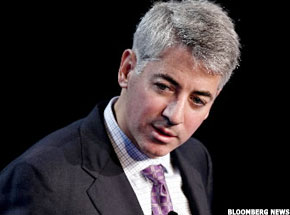
Bill Ackman, CEO of Pershing Square Capital Management
Bill Ackman, CEO of Pershing Square Capital Management.

He took a long position in General Growth Properties(GGWPQ.PK Quote) in November 2008 and then watched the stock go from 35 cents to more than $13. The company is now the subject of a bidding war between Simon Property(SPG Quote), Brookfield Asset Management(BAM Quote) and possibly Westfield and Vornado Realty Trust(VRO Quote)

He also ran a high-profile proxy contest against Target(TGT Quote) last year that failed to win him a seat on the retailer's board, although Target's shares are still still up substantially since he launched the contest.

Unlike most funds run by activist investors, Ackman's is not a long-only fund. He typically holds eight to 10 positions, with a couple of those being short. Because of that positioning, he's done well over the last few years and has remained active and outspoken.

Always a good speaker, Ackman has definitely ramped up his media appearances over the past couple of years. Pershing Square now manages more than $6 billion in assets, with a team of six investment professionals including Ackman.

Ackman describes the fund's strategy as "concentrated, fundamental, research-intensive, and long-short." The fund charges investors 1.5% in annual management fees and 20% in incentive fees.

Pershing Square has averaged 24% annualized returns since its founding in 2002. At the moment, the fund is 23% in cash.

It never uses leverage and almost never invests in industries that use a lot of leverage, are highly sensitive to interest-rate shifts or are commodity-related. (According to Ackman, the one investment that violated this rule was Borders(BGP Quote), which has lost 95% of its value since Ackman invested in it, although Ackman says at these levels it's a great value.)

Ackman wouldn't describe his firm's strategy as activist, either on the long side when he's gone to battle with Target or on the short side such as with bond insurer MBIA(MBI Quote), which Pershing Square first shorted in 2002.

......

[This post is an excerpt of the full article, which is available on TheStreet.com by clicking here. Free Site.]

Sphere: Related Content

Wednesday, December 23, 2009

Intellectual Activism's Impact On General Growth

By Eric Jackson

12/23/09 - 06:01 AM EST

Stock quotes in this article: GGWPQ , SPG

NEW YORK (TheStreet) -- It used to be that activism was conducted by poison letters to management from Dan Loeb, or by acerbic rhetoric leaked to the mainstream press from Carl Icahn. But a new kind of activism is being waged by leading hedge funds with positions on both sides of the trade in bankrupt mall owner General Growth Properties(GGWPQ Quote).

Pershing Square Capital Management, Hovde Capital, and T2 Partners are taking turns exchanging their analyses on why they think the stock is under- or over-valued. These intellectual arguments aren't just academic pursuits. They're having large effects on the stock price. Some of the smart money will be right, while others won't look so smart a year from now. Here's what you need to know to take advantage of this new kind of activism.

General Growth started in 1954, when two brothers founded a strip mall in Cedar Rapids, Iowa. The company hit a $20 billion market capitalization in April 2007 and is now one of the top mall owners in the country today. But General Growth took on a lot of debt in the credit expansion and was unable to roll over this debt when the lending markets froze, leading to their bankruptcy in April.

The company entered bankruptcy on April 16 with its common shares trading then at 60 cents each The shares have had quite a run since then, touching $12 two weeks ago.

Back in May of this year, Bill Ackman of Pershing Square profiled the bullish case for General Growth at the Ira Sohn Research Conference. He laid out a convincing case for the unique value embedded within General Growth. Unlike the vast majority of bankruptcies, Ackman argued General Growth's was unusual because its net assets were greater than its net liabilities. The company had a liquidity issue, not a solvency issue, Ackman said. Occupancy rates were still high, net operating income (NOI) was steady, and the company owned some of the more prestigious malls in the country across a wide footprint, he contended.

In the extremely conservative scenario, Ackman suggested that the equity value of General Growth was $10 per share at that time. With more normalized assumptions, giving value to the management company and several undeveloped properties and assets, Ackman said the equity value per share would be above $30. As long as the broad economy didn't sink into a severe recession, Ackman said he expected there would be value for equity holders after creditors were compensated.

[This post is an excerpt of the full article, which available on TheStreet.com by clicking here.]

Sphere: Related Content

Wednesday, June 03, 2009

Why Ackman Failed vs. Target

06/03/09 - 02:19 AM EDT

TGT

Eric Jackson

When Bill Ackman of Pershing Square Capital Management attended Target's (TGT Quote) annual meeting in suburban Milwaukee last Thursday it was the final culmination of a months-long proxy fight with the company's incumbent board. Although some observers, including me, predicted Ackman's slate would win one or two seats out of the five he was seeking, he came away empty-handed. Target announced at the meeting that all incumbent directors were re-elected with at least 70% of the vote.

The mainstream press immediately declared it a rout against Ackman. "Target Triumphs Over Ackman" said BusinessWeek, "Ackman Misses Target" said the New York Post. The New York Times headline read, "Target Shareholders Strongly Reject Dissident Slate."

But the truth is that the vote was far closer than how Target spun it.

The language from Target's press release includes words like "shareholders appear to have" elected the incumbent directors by a "comfortable" margin. Gregg Steinhafel, Target's chairman, president and CEO, goes on to thank shareholders for their "overwhelming" support of management. Towards the end of the press release, Target suggests it will get around to actually releasing "preliminary" voting results in three to four weeks. Final results will come later, but no timeline was provided. Technically, Target doesn't have to share the final results until the end of August -- 60 days after the end of the quarter in which the annual meeting took place.

I find it insulting to shareholders that companies can get away with not releasing voting results immediately after the meeting. A month ago, Bank of America(BAC Quote), a much larger company than Target, with more votes to be counted, and also facing a large number of dissenting shareholders, provided a detailed accounting of its tally before 5 p.m. the same day as the meeting. Target gets to drag its feet for three months, while posturing to the press working on deadline that it enjoyed a sizable win.

Doesn't this sound more like how a banana republic runs itself, rather than one of the largest retailers in the world?

Another aspect of the vote that inflated the results in Target's favor were the broker non-votes. We are now close to the end of the 2009 proxy season. Thanks to some recent changes by the Securities and Exchange Commission this will be the final year in which brokers can take all the non-votes they receive from their underlying shareholder clients and, in one fell swoop, throw the votes to management's favor. This happens in 99% of the cases in which they vote.

The Wall Street Journal recently concluded that, in most large company votes, these broker non-votes going in support of management amount to 15% to 20% of the overall votes counted. These votes should count as abstentions, since the real owners of the shares haven't indicated a preference. Starting in 2010, thanks to the SEC, that will happen.

Let's assume Target received the "overwhelming" support of 70% of their shareholders. Assuming a normal amount of broker non-votes landing on Target's side of the ledger, it appears that the vote, if it had taken place under next year's rules, would have been up for grabs.
Scott Galloway, New York University Stern School professor and activist investor with Firebrand Partners, who also serves on the New York Times (NYT Quote) and Eddie Bauer (EBHI Quote) boards, sent a tweet out after the vote saying that it was "a blow to activists everywhere." For the reasons I've outlined, I'm more sanguine. However, I think it's important to understand where things went wrong in this campaign, as I certainly thought Ackman had adequately made his case sufficiently to win at least a couple of seats.

Here's how things went off the rails for Ackman.

1. Winning a proxy contest is like passing a major bill in Congress. It's not enough to be right, an activist has to put forward an argument that is politically palatable to other shareholders. Ackman ultimately failed in his proxy contest because he failed to win over the support of the biggest holders such as the large mutual fund companies and pension funds.

Although these investors pay close attention to corporate governance matters, their primary concern as fiduciaries is the long-term health and success of the company. Activists sometimes shoot themselves in the foot with these shareholders when they advocate solutions that are perceived to provide only a short-term boost to the stock instead of a more sustainable move. Ackman's real estate investment trust plan for Target, designed to unlock value in the land under Target stores, and creative from a financial engineering perspective, got no support. It was successfully painted by Target as "risky" and out of step with the current environment. Ackman never should have included it as part of his plan.

2. The messenger is a big part of the message. Any activist investor in a proxy contest should be able to convince fellow investors that they are advocating solutions which will benefit the company in the long term. Far too many activists formerly looked for short-term levers to pull to create value in their shares owned, such as paying out a large dividend, taking on debt, selling off a division to a private-equity firm, or doing a big stock buyback.

For the most part, these strategies have hurt the target companies. There are also many activists, and Carl Icahn is probably the most well-known example, who have cultivated an image of force and intimidation.

Hedge fund managers -- and activists especially -- are still seen by outsiders as short-termists. In the case of Ackman, he is who he is: a big New York hedge fund manager. He can't change that, but that image likely did bleed away potential supporters who, when they reviewed his REIT plan and heard about the number of Target derivatives he owned, prematurely dismissed his slate for not being a "long-term investor." In the final days before the vote, Ackman went out his way to issue press releases saying he was committed to holding his personal Target shares, not his fund's shares, for at least five years if he was elected to the board. By then, it was too late to change how he was viewed by his fellow shareholders.

3. Pick bulletproof fellow directors for your dissident slate. Ackman didn't help himself with the pick of Jim Donald as a fellow director on his slate. In TV interviews leading up to the vote, Donald didn't provide a compelling list of things he was going to attack once he got elected to the board. It fed into the view that Target wasn't really badly in need of improvement.

Ackman made a big deal of Donald's experience heading up Wal-Mart's (WMT Quote) grocery division, pointing out that Target should emulate Wal-Mart's performance there. Yet Donald also brought the baggage of his bio for being ousted from Starbucks(SBUX Quote) by the guy who hired him. It's not necessarily fair, but this baggage diluted the message Ackman was trying to get across.

4. The worse the stock performance track record of a company is the easier it is for an activist to make the case for change. Joe Nocera of the New York Times took Ackman to task for his Target activist campaign. Nocera questioned why Ackman would go after Target in the first place when the company's 10-year stock performance was actually better than Wal-Mart's. Not every poorly-performing stock makes an attractive activist target, but it's clear that poor performance is a necessary condition for any activist to win over broad support.

Under the SEC's 2010 proxy rules, just as many Target shareholders agreed with Ackman that Target's performance should have been better in recent years as other shareholders who would have sided with Nocera that all this was a waste of time. Yet, as Ackman made constant suggestions that Target should be more like Wal-Mart, it would have helped him more if there was clearly a stark difference between the stock performances of the two companies over some time. It wasn't compelling enough.

I am heartened by how many shareholders last week voted for an activist campaign that, although far from perfect, would have improved on the status quo at a sleepy board. Ackman made mistakes in this campaign that lost him the trust of the long-term holders of the stock. Even still, the final tally likely will show a very close contest.

And next year's new rules from the SEC will mean that investors like Ackman will no longer have to pay $15 million to run proxy contests. Target's vote is more likely to be an early warning of future activist successes than a death knell.

At the time of publication, Jackson owned no shares in the companies mentioned.

Eric Jackson is founder and president of Ironfire Capital and the general partner and investment manager of Ironfire Capital US Fund LP and Ironfire Capital International Fund, Ltd.

Sphere: Related Content

Wednesday, May 27, 2009

Ackman Vs. Target

05/27/09 - 12:07 AM EDT

TGT , WMT , COST

The much-anticipated annual meeting of retailer Target(TGT Quote) is Thursday and large shareholder Bill Ackman of Pershing Square has been in a long-running battle for the past several weeks to win five seats on the board.

Ackman has spent $10 million to $15 million of his own money on his campaign thus far. Although he's won over the support of two influential proxy advisory firms -- RiskMetrics and Proxy Governance -- he faces a daunting task in winning Thursday's vote. In its latest issue, Barron's magazine proclaimed that Ackman's campaign was "off-target," stating that "Ackman's initiative could be one of the worst-conceived efforts in recent years by an activist investor."

On Tuesday, Ackman pledged to retain his stake in Target for at least five years if he's elected to the company's board. He said his personal stake in Target is now worth more than $55 million.
Here's my view on the campaign.

A Review of the Fight

Ackman's Pershing Square has been a shareholder in Target for more than two years. In 2007, he opened Pershing Square IV, which was a fund solely dedicated to investing in Target. Pershing's funds own 3% of the stock outright with options to purchase at least another 2%, many of which are already in-the-money.

From very early on in his stock ownership of Target, Ackman has been an outspoken critic of the company. His calls for the company to unlock value in its real estate holdings date back to at least 2007.

Earlier this year, Ackman apologized to investors in Pershing Square IV after his option bets on Target had gone against him resulting in a drop in fund performance of 89.5% as of the end of January. Target management has used Ackman's option holdings to imply that he's more a short-termist than other investors and that his proposed changes are riskier.

Ackman's plan for Target consists of four parts: (1) unlock up to $40 billion in real estate value by placing the land under the stores in a real estate investment trust structure and then leasing back the land from the REIT; (2) sell the entire credit card operation; (3) improve the quality of the board of directors; (4) close the performance gap over time with Target's No. 1 competitor Wal-Mart Stores(WMT Quote).

Proxy Governance has supported Ackman's activist efforts and his full slate of nominees for Target's board. RiskMetrics, the more influential of the two proxy advisory firms, has recommended two of Ackman's five nominees (Ackman himself and Jim Donald, the ex-CEO of Starbucks(SBUX Quote)). Glass Lewis, another proxy advisory firm, has rejected Ackman's nominees and supports Target's full slate.

In the weeks leading up to Thursday's vote, Ackman has taken to the airwaves to make his case. He's an exceptional communicator. He's clear, thoughtful and forceful in making his case. I don't think there's a better activist investor currently practicing today when it comes to communication skills.

Target, for its part, also has been pushing its rebuttal to Ackman's criticisms, taking 10 minutes at the beginning of its most recent earnings call to cast doubt on the Pershing plan.

What's Worked With Ackman's Campaign

1. Target's performance has clearly lagged Wal-Mart's recently, and that's relevant. Barron's includes figures in its article that show Target's total three-, five- and 10-year returns vs. Wal-Mart, Costco(COST Quote), and the S&P 500. The results are through April 30, and cite Morningstar. The reported returns imply that Target's returns have been pretty good on a five and 10-year basis, even though they've lagged their peers in the last three years.

I was incredulous after reading this and so I went to Morningstar to revisit these numbers. What I found on its site tells a different story than the Barron's numbers. On the currently reported numbers (through May 22), Target's year-to-date, one-, three-, five- and 10-year returns all clearly lag their industry and the S&P, although the five and 10-year are roughly comparable with Wal-Mart).

2. This Target board is out of touch, like many corporate boards. There are many compelling points Ackman makes about how out of touch the Target board has become. Its directors currently own only 0.27% of the total Target shares outstanding. Many directors only hold shares given to them through options or equity grants. They've consistently relaxed the director tenure limits to allow directors like former Telstra CEO Sol Trujillo to serve up to 20 years on the same board.

Most corporate governance experts would tell you that a director no longer has "fresh eyes" to look at a company's issues and challenges after eight years on the same board. A two-decade term limit is outrageous. It's also ridiculous to hear that Target's nominating committee refused to meet with Ackman or his nominees about joining the Target board last year but paid themselves fees for sitting on this committee, even though that committee didn't meet once formally during the year. I can't recall seeing that in a recent large company proxy.

Target's board deserves a revamp. Its practices suggest a cozy group of insiders seeking to protect their job security as directors, rather than doing the right thing for shareholders. Things likely will change significantly in future boardroom battles, as last week the Securities and Exchange Commission threw its support behind "proxy access," which would make it much less expensive to mount campaigns and give shareholders a real choice in who they want to represent them on the board instead of only choosing from the incumbent slate. If Target's board doesn't change Thursday, it most certainly will next year.

3. This is a legitimate campaign -- not a distraction. As the Barron's article stated over the weekend, there is no shortage of management apologists who come out of the woodwork when there is a dissident proxy fight. Most of the time these commentators who support the status quo usually complain that the company isn't the worst of the bunch and therefore an activist campaign is a waste of time and a distraction.

That approach has allowed mediocre boards to persist in this country for decades. As the points I've mentioned verify, this campaign certainly has merit. What's more, Ackman has paid his way to put it on. He has real "skin in the game" -- unlike most, if not all, of these kinds of critics. The fact is that if more mediocre boards had been "distracted" by legitimate activist campaigns over the past two years it's likely we'd have a much stronger capital markets system today than the one which absolved itself of any risk management responsibility.

4. Ackman's made a great case. I tip my hat to Ackman, including his spirited attack of the Barron's article, for being a very precise and skilled communicator. I think he's made about as strong a case as an activist can make at this time against Target.

What Hasn't Worked

1. Target's poor performance relative to Wal-Mart hasn't been compelling enough. It's hard to win an activist campaign arguing what Target should have done in the last few years. Shareholders are human. They take short-cuts, they summarize, they look for sound-bite logic for understanding a campaign, and then they base their voting decisions on this incomplete information. Some shareholders rely heavily on what the major proxy advisory firms say when deciding how to vote. Although Ackman's made some salient points on how Target has lagged Wal-Mart, he will not gain as much shareholder support as he could have if the gap had been much more compelling.

2. The REIT component of Pershing's plan doesn't match today's environment. A large part of Ackman's plan includes increasing shareholder value through creating a new Real Estate Investment Trust. It matters not that Target uses Richard Sokolov, the president of Simon Property Group (SPG Quote) (who competes against General Growth Properties, of which Ackman is a large owner), to discredit Pershing's plan. The optics of the plan don't match the current environment we're operating in even if the substance of the plan is on the mark. It will be difficult to convince many investors to take a leap of faith on a sudden creation of $40 billion in value from moving a few shells around. At the moment, skepticism reigns.

3. Jim Donald's communication skills haven't matched Ackman's. As RiskMetrics' recommendation confirms, there appears to be the most support for Donald as a second pick for the Target board after Ackman.

During a recent joint CNBC appearance, Donald, who also helped build Wal-Mart's grocery business before leaving for Starbucks, failed to match Ackman's oratory skills. When someone questioned Donald about what changes as a director he'd like to see Target make, he deferred, saying that he needed some time to study things in more depth. It was modest and diplomatic but not in keeping with a bloody-nosed proxy fight.

What's more, it played to what Target has tried to press -- that there's nothing that significant to fix at the company. It would be ideal if all shareholders took the time to review all candidates' utterances prior to forming their selections, but unfortunately sound bites matter, and that one hurt.

When all is said and done Thursday, I expect that Ackman will win two seats on the Target board, along the lines as RiskMetrics suggests. In the long run, it should greatly help Target's other shareholders and prove the naysayers wrong. Ackman hasn't run a perfect campaign, but it's been very effective, and he will consider it a success with this kind of outcome. It also will give him the chance to further press his views at the board level. It's likely that Thursday's showdown will be a preview of many more activist contests to come next year, once the new SEC proxy access rule goes into effect. Sleepy boards should get ready for more distractions.

At the time of publication, Jackson had no positions in the companies mentioned.

Eric Jackson is founder and president of Ironfire Capital and the general partner and investment manager of Ironfire Capital US Fund LP and Ironfire Capital International Fund, Ltd.

Sphere: Related Content

Sunday, May 10, 2009

Cheering for Bill Ackman at Target (TGT)

I read Jesse Eisinger's great profile of Bill Ackman of Pershing Square in my final copy of Portfolio Magazine.

Bill took some shots when his Target (TGT)-only fund was down 93% earlier this year. He had to apologize to his investors, loosen the fund terms and injected $25 million personally into the fund. AG Andrew Cuomo even called Ackman up to compliment him for how he handled the situation.

The last I heard, Ackman's TGT-only fund's return was -50% -- still a big loss, but a remarkable achievement in a little over a month off the bottom. This jump corresponds with TGT's move from its early March bottom of $25 to around $40 today.

Ackman's results show how quickly a one-investment fund, combined with the use of options, can see performance dramatically increase (or decrease). (Ackman has already said he'll likely never do a single investment-fund again.) There is still a good chance that this formula will assure he returns all the original money to his investors and, who knows, maybe even return them a small profit.

I'll be cheering for Ackman. He's got ideas in spades, which is something the world needs more of these days. And, besides, who doesn't love a happy ending?

Position: None.

Originally published in RealMoney.com on 5/6/2009 1:37 PM EDT

To get Eric Jackson's real-time updates, subscribe to RealMoney.com

Sphere: Related Content

Monday, April 06, 2009

Activist Investors Sidelined by Brutal Market

From TheStreet.com

By Eric Jackson

04/06/09 - 12:12 PM EDT

S , HD (Cramer's Pick) , MOT , WEN , TIF , CSX , TGT , YHOO

Earlier this year, Ken Squire, who runs the consultancy 13-D Monitor, which follows those filings with the SEC, wrote an article in Barron's predicting that 2009 would be a "golden age" for activists (which I also predicted recently).

His article made several strong points for why this should happen, including the low valuations, a favorable political climate likely to ease hurdles for activists to challenge companies, and shareholder discontent at record levels. Yet, this activist activity has yet to materialize. Why and when will this change?

There is a finite set of large activist investors in the world today with the assets to take on large public company battles. Some of the biggest have included: Relational Investors (active in Sprint(S Quote - Cramer on S - Stock Picks), Home Depot(HD Quote - Cramer on HD - Stock Picks), and National Semiconductor(NSM Quote - Cramer on NSM - Stock Picks) last year), Trian (active in Wendy's(WEN Quote - Cramer on WEN - Stock Picks) and Tiffany's(TIF Quote - Cramer on TIF - Stock Picks) last year), Carl Icahn (active in Yahoo! (YHOO Quote - Cramer on YHOO - Stock Picks) and Motorola (MOT Quote - Cramer on MOT - Stock Picks) last year), The Children's Investment Fund (or "TCI," active in CSX(CSX Quote - Cramer on CSX - Stock Picks) last year), Jana Partners (active in Cnet last year), and Pershing Square (active in Target(TGT Quote - Cramer on TGT - Stock Picks) last year).

Like most investors, they had terrible results last year, although their previous 10-year returns have been outstanding. These activists suffered more in 2009 than other hedge funds because of two reasons: (1) they typically run long-only or long-biased funds and therefore had very little hedged going into last fall and (2) they have concentrated portfolios of typically fewer than 15 holdings, which can work very well in up years but terribly in down years.

These large activist funds have seen heavy redemptions in the last six months, and there is no reason not to believe they won't see more for the balance of this year. Even Jana Partners, which had relatively positive returns in 2008, has been hit with large redemption requests reportedly affecting 20% to 30% of assets.

As a result, all of them have pulled in their horns on potentially new activist campaigns, in favor of working out existing investments. Some activists are even exiting existing investments, after spending significant time and money on winning board seats (e.g., Relational exited its Sprint investment and TCI plans to exit its CSX investment later this year), in order to focus on a smaller set of investments within their portfolio.

To meet redemption requests, large activist founders have had to inject significant personal capital into their funds. Carl Icahn, whose fund was down 36% last year, put $500 million in. Bill Ackman recently invested a further $25 million in his Target-only fund Pershing IV.

Christopher Hohn, founder and head of TCI, who was recently regarded as one of the top activist investors in the world (and who some former employees cattily referred to as the "Sun King" made waves recently when he indicated he is considering turning his back on activism.

He complained at a recent investor day that activism was too "expensive and unpredictable," citing the recent $10 million spent by his firm on a bitter proxy battle with CSX last year (which he ended up winning, taking four board seats. He plans to give up those seats at the next annual meeting, possibly signaling an intent to sell CSX shares later).

The redemption siege mentality gripping large activist managers (which carries over to other hedge fund managers as well) is, in my opinion, the biggest reason for the drop in large activist battles. The New York Times recently reported that new activist campaigns dropped by nearly 80% in the fourth quarter of 2008 compared to a year earlier, according to data from Thomson Reuters, and activists made 59 new investments last month, compared with 87 a year earlier, according to Hedge Fund Solutions.

Of course, the evaporation of credit has taken away one "quick fix" strategy out of the quiver of some activists: Call on the company to take on an unhealthy amount of debt in order to buy back shares to artificially boost EPS and immediately dividend out this cash to shareholders -- all in the name of "creating shareholder value."

Marty Lipton, who has been corporate America's top watchdog against activist investors, recently attacked these kinds of practices, asking: "Can the global economy afford to allow institutional investors, who are seeking to maximize the price of their shares on a daily basis, determine industrial business, policy and strategy of major corporations?"

Of course, there are examples of bad behavior at both ends of this spectrum: greedy, short-termist activists enriching themselves at the expense of long-term holders, and greedy, out-of- touch boards and CEOs filling their own pockets out of the company till while driving a company's value into the ground. There can be highly effective boards and CEOs, as well as highly effective activist investors who advocate actions that are in the company's and its long-term shareholders' interests.

The fact is that Ken Squire's thesis is still correct that the broader environment has made it much more favorable for activist investors to launch campaigns. There are many companies today trading at or near their cash levels. Some of these companies are in this situation due to the wash-out of the broader market, but many are there because of their boards approving poor capital allocations (buying back stock at the top of the market or taking on large amounts of debt which cannot be rolled over), poor acquisitions, excessive compensation, or simply leading their company to value-destroying mediocrity.

A year from now, the SEC is likely to approve a new "proxy access" rule making it much less expensive for activists and other shareholders in general to challenge boards doing a poor job representing their interests in overseeing the company's direction. It's likely that many smaller activist investors will be involved. The most active activists today are the firms going after companies below $2 billion in market capitalization -- on the assumption that they can have more sway over these companies because they can hold a larger percentage of shares than would be possible if they went after the larger public companies.

Yet even the most favorable conditions will promote activist campaigns against large-cap companies if the current generation of large activists continues to be inwardly focused by their redemption and performance problems.

This could be a generational succession moment for activist investors, where the elders give way to a next generation of activist investors taking on the largest companies in corporate America.

For this next generation of activists to successfully take over this mantle of their industry, they must do the following:

  • Hedge, in order to preserve partner capital in the event of terrible years like 2008. The days of long-only are over.
  • Build a reputation for always doing right for shareholders (especially long-term holders). Some of the "quick fix" activists of the last five years never won the trust of large mutual funds and pension funds, who tend to be the biggest holders of stock of the large-cap companies. As a result, proxy contests failed to win over the support of this important constituency, for fear of how these activists would represent their interests properly.
  • Focus more on strategy and operations, less on single events. There will always be a place for activist investors to go after a company, advocating they sell a single division, or do a quick dividend to shareholders. However, these situations tend to be more prevalent in small-cap companies. Large-cap companies, by definition, have more complex problems and require more complex solutions. The next generation of top activists will understand this and have deep expertise in their firms on strategy and operations.
  • Use the tools of the Internet and social networking. In 2007, when I ran a successful activist campaign against Yahoo!, which resulted in unseating Terry Semel as CEO after a large "no" vote at the annual meeting, I owned 96 shares of Yahoo! However, I was able to get my message out to large and small shareholders via my blog, YouTube, wikis, Facebook and Twitter. More than calling attention to my ideas, these social networking tools allowed fellow shareholders to pledge support to my group and encouraged them to suggest additional ideas for how Yahoo! could improve. I was most surprised and pleased with how many existing Yahoo! employees participated. Yet, their interests were perfectly aligned with our groups: We were all stockholders of Yahoo! and wanted to see the stock price go up through needed changes, which the current board and management were not making. The next generation of large activist investors will be masters at using the Internet to conduct their campaigns.
  • Be more collaborative, less combative with target companies. It will always be necessary to run successful -- sometimes nasty -- proxy contests against entrenched boards and management. In my opinion, the Yahoo! board, for example, will never respond to a "nice guy" activist approach. It is so entrenched and disconnected from the opinions of shareholders that it would be impossible to reason with them. There's a time to knock heads. However, some activists only knock heads. They only know how to hit one key on the piano. The next generation of activist investors will be able to play hard ball but tend to be much more collaborative with the board and the CEO -- at least at the beginning, until reasonable dialog leads nowhere. Such an approach is also far less expensive than an "all-negative, all-the-time" approach.

There is a job opening in the activist investor industry. Wanted: the next generation activist investor leaders to take the lead in waging successful campaigns against large cap companies. Who will assume the mantle? We'll see over the next few years.

At the time of publication, Jackson was has no positions in stocks mentioned.

Eric Jackson is founder and president of Ironfire Capital and the general partner and investment manager of Ironfire Capital US Fund LP and Ironfire Capital International Fund, Ltd.

Sphere: Related Content
Thursday, December 11, 2008

TheStreet.com: Why 2009 Will Bring More Activism

From TheStreet.com:

By Eric Jackson

12/11/08 - 09:59 AM EST

With the market's tumultuous last few months driving down the price of equities, activist investors around the world have seen their stock investments take major hits.

  • Carl Icahn has watched the value of his Yahoo! (YHOO Quote - Cramer on YHOO - Stock Picks) stake drop in half since May;
  • Ralph Whitworth of Relational Investors recently resigned from the board of Sprint Nextel (S Quote - Cramer on S - Stock Picks) but kept his stake in the company, even as shares have dropped 80% this year;
  • Chris Hohn of The Children's Investment Fund exited his J-Power position at a loss earlier this year, after his calls for change were beaten back by the Japanese utility. Some market-watchers suggest that after 10 to 12 years of growth as a strategy, investor activism is dead. Why? Poor returns, they say, and because the freezing-up of the credit markets prevents activist shareholders from calling on companies to lever up with debt to fund stock-buyback plans or increase dividends.
However, 2009 could very well prove one of the busiest years for activist investors in the last decade. I count 10 reasons why.

1. Obama will look favorably on pro-shareholder measures. Republican Securities and Exchange Commissioners have typically supported pro-management/Business Roundtable policies. Democrats have been much more supportive of shareholder activists. The Business Roundtable and other pro-management groups have portrayed shareholder-friendly measures -- such as making it easier to run alternative board candidates on the company's proxy -- as moves that empower fringe, or special interest, shareholders such as the AFL-CIO and Teamsters at the expense of plain-vanilla investors (retail or institutional).

Obama supports a different view and will likely equate more shareholder rights that promote better governance with better shareholder returns over time.

2. The new SEC Chair will sponsor several new shareholder-friendly measures. Obama will appoint an SEC chairman in the image of the last Democrat to hold that position, Arthur Levitt -- someone who will fight for openness, fairness and rights for all shareholders.
"Proxy access" was an initiative supporting the rights for shareholders to put forward alternate names of directors to be elected at the annual meeting proxy vote. Instead of having to fund a proxy contest themselves (vs. an incumbent board funding their re-election with the shareholders' money), "proxy access" would have allowed for these alternate names to appear on the company's own proxy and let the shareholders simply vote for the most qualified people to represent shareholder interests. This initiative died when the two Democratic SEC Commissioners retired and were not replaced.

Expect "proxy access" to return in the new administration in some form, helping to ensure the best possible people are serving as directors on our boards.

3. Valuations are on the floor. Activist investors are typically value investors who layer their activist efforts on top of a buy-and-hold approach to an undervalued stock. Value investors have been especially hard hit this year. Fortunately, the mass selling appears to have stabilized. While cheap should never be confused with value, it's likely that valuations will rise over the next 12 months and take the fortunes of activist investors with them.

4. A flight to quality in hedge funds will benefit activist investors. The hedge fund industry is going through a remaking of itself and will no doubt be a much smaller industry two years from now. The biggest and most successful ones will grow in a flight to quality. Activist investors with long and successful track records will benefit, even if their returns in 2008 are poor. Institutional investors can understand the activist strategy and how it's executed. It's not a black box and that is going to be helpful to activists in raising capital over the next few years.

5. Management and corporate boards will not want to be viewed as anti-shareholder. After seeing their market capitalizations decimated over the last 12 months, boards and management teams at public companies are sensitive to criticism. Lavish pay and executive perks are out. Assuming activists have legitimate arguments about actions that will unlock shareholder value, it will be much easier for them to get the ear of managements and boards in the next 24 months.

6. There will be a wave of industry consolidation. M&A has dried up in 2008 as corporate acquirers and targets kept their heads down in the foxhole. That's about to change. With valuations so low, there's never been a better time for stronger players to pick off the weaker ones in their industry.

At the same time, no board wants to make the mistakes that Yahoo! and Take-Two (TTWO Quote - Cramer on TTWO - Stock Picks) did this year by playing hard to get when a rich buyout offer came along. Activist investors will play a background role. For example, look for Bill Ackman of Pershing Square to push together Barnes & Noble (BKS Quote - Cramer on BKS - Stock Picks) and Borders (BGP Quote - Cramer on BGP - Stock Picks) (as he has a stake in both companies).

7. Activists have the longest lock-up periods of any hedge fund class, so they can put fresh capital to work. With hedge funds reeling from heavy redemptions, the funds in the strongest position this year are the ones with the longest lock-up periods. A lock-up is the amount of time a hedge fund investor must keep his/her money invested in the fund before being able to redeem.

Activists, at least the most successful ones, have among the longest lock-ups in the hedge fund industry, at 3-5 years. The logic for asking for such a lock-up is that activists understand that their hold period in a particular position might be many years, comparable to a private equity holding period. Unlike private equity, though, activist investors have their positions marked to market every day.

Activists know a six-month investment return in Sprint is likely to differ from a three-year investment return. With these long lock-ups, activists will be less affected by heavy redemptions this year than most other hedge funds. This means they'll have more money to put to work next year.

8. Limits on short-selling will benefit activists. As previously mentioned, the SEC is about to become more shareholder-friendly under the new administration. The agency also will likely seek to promote growth in the stock market. Short-sellers could come under more restrictions, promoting long-biased investors. Although no outright ban on short-selling will occur, a return of the uptick rule is likely. Any limits on short-selling like this will help long-biased investors like activist investors.

9. Activists will become more balanced on the long and short sides. Even though activists have typically been long-biased or long-only before 2008, the only investments that have made money this year are short bets. Activists will learn from this year's action to have a more balanced portfolio of investments on the long and short sides. Some activist investors like Greenlight Capital and Pershing Square have always taken this balanced approach. Expect others to follow their lead. This will improve performance and provide them with more capital to put to work in additional activist campaigns.

10. There's more to get "active" about than ever. Even post-Enron and post-Sarbanes-Oxley, 2008 has shown shareholders that there is more than ever to get outraged by in the actions and inaction of corporate boards.

Where was the oversight at Bear Stearns, Lehman, Citigroup (C Quote - Cramer on C - Stock Picks) and GM (GM Quote - Cramer on GM - Stock Picks) this year?

We hear a lot of CEOs and boards refer to a "perfect storm" occurring this year, an attempt to place responsibility for their companies' results on events outside of their control. Bob Rubin, director at Citigroup, recently said it wasn't realistic to expect a year ago that housing prices would drop as precipitously as they have. Although no omniscient board has yet been found, there are many that did an excellent job at protecting and growing capital in the last year.

As activists challenge the poorer-performing boards, the result will be stronger companies and better performance in the future. If these shareholder representatives are not questioned and are allowed to continue rubber stamping the will of management, we will have learned nothing from the debacle of the last 12 months.

At the time of publication, Jackson and his fun had no positions in stocks mentioned.

Eric Jackson is founder and president of Ironfire Capital and the general partner and investment manager of Ironfire Capital US Fund LP and Ironfire Capital International Fund, Ltd.

Sphere: Related Content

Monday, June 16, 2008

WSJ.com: Let My Short-Sellers Go

Posted by Heidi N. Moore

June 12, 2008, 11:26 am

There are short-sellers, and then there are short-sellers.

So says activist hedge-fund manager William Ackman, the founder of Pershing Square Capital Management and scourge of companies ranging including bond insurer MBIA. Ackman’s attentions are currently focused on retailing giant Target.

In a conversation with Deal Journal’s Dennis Berman at Wednesday’s Deals & Deal Makers conference, Ackman addressed one of the hot questions of the day: are short-sellers (such as David Einhorn) being irresponsible when they advertise their negative views of companies? Or are these investors, who profit when stock prices decline, helping to keep the markets informed?
Ackman, who declared himself a passionate advocate of the First Amendment, said it depends.

Short-sellers who try to spread rumors in the market, he noted, should be prosecuted. But short-sellers who have done an analysis of a company’s financial standing should be free to make their points publicly. “Is there room for a 40-to-1 levered institution that is so fragile that a 38-year-old short-seller can go on TV and shake confidence?” Ackman asked. “If the whole country is only long, on margin, we’re going to have bubble after bubble. We want businesses that can stand critique by any investor.”

Ackman, of course, has experienced first-hand the backlash from companies against short-sellers. In his battle with MBIA in 2002, Ackman wrote a 66-page report about the company’s risky investments and had several lawyers look it over, and made it available to investors. The company sicced Eliot Spitzer on him, alleging that he was trying to manipulate the stock to his advantage. The SEC followed but dropped its investigation. Einhorn also ended up in an SEC investigation prompted by his remarks about small-business development concern Allied Capital. “If this is the regulatory response to someone criticizing a public company,” Ackman noted, then things are dire indeed.

Ackman unabashedly supports the rights of short-sellers like Einhorn to make their points in public forums. He argued that if Lehman had listened to Einhorn in November and raised capital to forestall concerns about its capital position, the securities firm could have avoided some of its current perception troubles and Einhorn would have posted losses on his short bets. “If the firm listened to Einhorn back then and raised capital, perhaps it wouldn’t be in these straits,” he said. “If you’re long, you can go into Barron’s and pump your stock and no one looks askance. If Einhorn says, ‘I have concerns about Lehman’s balance sheet,’ the New York Times writes a scathing article.”

Sphere: Related Content