Paulson is About Performance


There were two reactions I got to my column last week on Greg Zuckerman's new book The Greatest Trade Ever about John Paulson's $20 billion bearish housing trade in 2007: "He was lucky" and "He won't do it again."
Even though these comments are mostly sour grapes, here's the problem with overanalyzing winners -- for the financial media, potential investors and even money managers, like Paulson himself.
Our society celebrates winners (athletes, politicians and investment managers like John Paulson) and ignores losers. From 1994-2007, in the eyes of many, Paulson was a loser. His hedge fund, Paulson & Co., had mediocre returns during this period. He was defined as a merger arbitrage guy. Because of this categorization, some investors were alarmed by his ideas about betting against the housing market using credit default swaps. Yet, he did -- and we know the results.
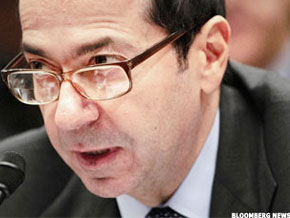 |
| John Paulson, hedge fund manager |
Although his pre-2007 performance didn't stand out, people who knew Paulson thought highly of him, according to Zuckerman. Investors were often impressed with his understated but effective way of clearly articulating his investment theses.
Post-2007, the perception of Paulson went from career underachiever to seer. He is now celebrated, and his recent stakes in Citigroup(C Quote), Bank of America (BAC Quote) and gold are seen as green lights to other investors to buy.
If Paulson told us tomorrow that Martians were going to invade us next month, there would be a run on Martian army gear.
Yet, this reaction is equally superficial in the opposite direction. We don't care why he thinks gold is a buy or why Bank of America will double in two years. This isn't Paulson's fault. He can't help it. It is the reality that's developed around him while he's gone about his business trying to make money for his investors. It's exactly the same as the heavy attention paid to Warren Buffett's moves.
This is classic "survivorship bias." There were 20,000 hedge funds in the halcyon days of 2007. No matter what the markets did over the next 18 months, five to 10 funds would have had scored 100%-plus returns and been celebrated. If Bernanke had cut interest rates drastically in 2006, maybe New Century would have continued to be a huge moneymaker by issuing subprime mortgages.David Einhorn would be known today as having the canny intuition to get long that stock (and join its board) in 2006, instead of for calling Lehman's implosion in early 2008. Had the housing boom continued, perhaps Greg Zuckerman's book would be about former Bear Stearns hedge fund manager, Ralph Cioffi. Of course, this didn't happen and, instead, Cioffi is fighting civil charges by the SEC, and John Paulson is the hero.
Survivorship bias leads to celebrating the winners and -- usually -- overinterpreting their moves leading up to their success and trying to apply these actions to future situations. At least no one in the mainstream media has yet called John Paulson "the next Warren Buffett."
Remember Eddie Lampert? That's what Business Week and countless other magazines called him back in 2004. Although many still defend Lampert as smart, his past five years of performance have been very disappointing, and his Sears Holdings(SHLD Quote) investment specifically has been ... early.
Although it's easy to pick on the financial media for these flubs in hindsight, they are merely reflecting our own deep-seated human desires for making sense of a seemingly senseless market. They wouldn't tell us who'll be the next Warren Buffett, unless we wanted to buy their magazine (or click on their links) to find out. We gravitate to "winners" for pearls of wisdom to help us be more winnerlike.
This is why investors "performance chase." The best performing hedge funds (and mutual funds) will always attract the most capital. After all, performance is what it's all about. Most investors will overlook lots of quirks, ethical lapses and hard-to-follow musings about the state of the markets in investor letters, if the money manager performs.
The longer and better he or she performs, the more leash we give him or her (like Madoff) or the more we celebrate him (like Peter Lynch, Lampert and now Paulson). But past performance (and a fund's ability to raise capital) is no guarantee of future success.
Investors should judge money managers on their current ideas. If you'd done so when John Paulson made his argument for why to bet against housing in 2006 and 2007 -- despite the fact that he wasn't a "housing guy" -- you made a lot of money. His pro-gold and pro-financials views now should be also judged on their merits, not because "John Paulson thinks so." Of course, you and I will probably never have the chance to place money with Paulson. So this lesson becomes even more important. How are you going to know the next John Paulson when you bump into him or her?
Finally, let's turn to the critique of "Paulson will never do it again." Most people assume that smart people will, over time, outperform their peers. This is true. Yet, we also know smart people drove Enron, WorldCom and Lehman Brothers off cliffs -- all companies that, before their collapses, had been celebrated in the financial media with books written about them "getting it" while their competitors didn't. How can this happen and how can Paulson avoid this fate?
Michael Burry, a doctor-turned-hedge fund manager also profiled in Zuckerman's book, who also profited from betting against housing despite great protestations from his investors, had a memorable line: "A money manager does not go from being a near nobody to being nearly universally applauded to being nearly universally vilified without some effect."
Paulson's gone from obscurity to being perceived by many as the top hedge fund manager in the world. With that change, Paulson has received enormous wealth, but at a cost. His every trade gets discussed and debated in the media. He's likely become more isolated for security reasons, making it harder to relate to the "real world" in which his investments operate. And he likely has more "yes men" around him than ever before.
If you're on Paulson's team, you've made huge money recently. Unwittingly, you'll start agreeing with him more on his new investment ideas. Anyone who doesn't agree will probably leave on his own accord or be asked to leave. Those remaining on the team are the most loyal and the least likely to disagree with the boss' views. Active debate helps form great investment ideas. But, as money managers get more successful, they face less and less debate.
I disagree that John Paulson was lucky in betting against housing. From Zuckerman's account, Paulson did his homework, while everyone else stayed too long at the party. I also think that he can still conceive of and execute great trades. But there's no question that it will be more difficult now than before . Ask Lampert. Paulson's continued success is not his birthright.
Any investor choosing a money manager needs to remember the story of the emperor's new clothes. Managers like to dazzle investors with technical terms and fancy charts. However, they should be able to clearly and articulately explain their basic strategy. No amount of buzz or press clippings is an adequate substitute for clear-headedness. (In fact, if they seem overly concerned with their media appearances, this signals they care more about their image than managing your money.) You shouldn't worry about asking a stupid question. If they show a whiff of arrogance in responding to your questions, run away as fast as you can.
Answering these questions will help you skate to where the puck's going, not where it's been. It will also help you ensure differentiating between "flash in the pan" money managers from those with staying power. And, just maybe, you'll find the next John Paulson.
At the time of publication, Jackson fund held no positions in the stocks mentioned.
Eric Jackson is founder and president of Ironfire Capital and the general partner and investment manager of Ironfire Capital US Fund LP and Ironfire Capital International Fund, Ltd.
Sphere: Related Content


