Monday, October 16, 2006

What Have We Learned from Friendster?


Kudos to Gary Rivlin at the New York Times for his great piece yesterday on Friendster. If you didn't see it, the original article is here, and the follow-on coverage from Michael Arrington is here.

It is a great tale of how Jonathan Abrams (pictured left) started the site as a way to get a few dates, turned down a $30M buyout offer from Google (which would be worth around $1B in GOOG stock today), and opted to raise VC money from John Doerr of Kleiner Perkins and Bob Kagle of Benchmark -- trying to create the next big thing. However, the bigger buyout offer never came, Jonathan Abrams is gone, and Friendster did a recap in the Spring with DAG Ventures.

There are several lessons to be learned from the Friendster fiasco. They seem to connect well with recent research I've published on the Breakout Performance blog on the drivers of VC-Backed firms' sales growth, as well as comments we've made here on the topic of "Why Smart Executives Fail" and the 'Seven Habits of Spectacularly Unsuccessful Executives.'

Here's the abridged version of lessons learned from Friendster:

  1. Never forget basic blocking and tackling. In our research, we called this "basic attention to detail" -- something Jeff Bussgang has discussed. If the Friendster site doesn't load, who cares what Yahoo and Google might do next according to the SWOT analysis?
  2. Even with bluest of "blue-chip" VCs, success can never be taken for granted. None of us has the Midas-touch -- even John Doerr and Bob Kagle. Managers and directors alike need keep a spirit of "proactive paranoia" alive in all discussions. Succes is taken and kept; it's never handed over easily.
  3. Even if you're the smartest CEO in the world, arrogance can be a company-killer. It's not intellect which gets companies into trouble; it's arrogance. Listen to a comment to Arrington's post on Techcrunch in response to his covering this article: "I remember shortly after Friendster launched, and Jonathan Abrams was responding to comments — I made a few suggestions about how it might be a good idea to integrate blogs and rss feeds. My suggestion was laughed off by Abrams as being ‘too geeky’ for their audience — and his arrogance was clearly apparent. I stopped using Friendster from then on."

Sphere: Related Content

Friday, October 13, 2006

Terry Semel: Cause of Yahoo's Success or Along for the Ride?


It's an age-old question in the study of leadership: Do leaders really matter? In America (at least, outside of business academia), uttering these words is almost sacreligious. We crave heroes and scapegoats. Leaders help make sense of the world around us. Yet, there are some -- they call themselves "organizational ecologists" and, I have to say, they weren't too popular with the MBAs in B-School) who say: no leader in today's large corporations make that much difference. Take anyone else of a minimum ability level and they would do just as good a job. The die is already cast for them, given the company's size, resources, capabilities, and market position. I can hear all the management consultants and recruiters out there shuddering at this notion. And I also believe it's ridiculous. More than belief, there's empirical evidence that the right leaders do matter and can confer significant financial and morale-improving benefits to their companies. By the same token, the wrong leaders can be a drag.

Yet, the ecologists raise an interesting question: If you put leader A in the CEO's chair at time 1, and if you put leader B in that same chair at time 1, what would be the difference in company strategy and performance at time 2? The question is really unanswerable -- yet, it makes for great conversation.

Which brings us to Terry Semel at Yahoo! There's a bit of a pile-on going on now in the wake of GoogTube. Google = fast-moving/innovative/smart; Yahoo! = slow-moving/pedestrian/dumb. Google pounces on an incredible strategic opportunity in buying YouTube. Yahoo can't get a deal done with Facebook and lets it drag on for months. The truth is rarely black and white; there's always more context than what gets printed. Yet, Terry Semel hasn't really helped himself with the Street or in the Valley. After Barron's touted them as ready to break-out of a holding pattern, they've proceeded to whiff on earnings, delay a major ad product, not do a deal with Facebook, MySpace, AOL, or YouTube, and forced their employees to take unpaid sick/vacation time this Christmas.

Who is Terry Semel?

Terry, 66 years old, was born in Brooklyn, NY. He joined Yahoo over 5 years ago, after 24 years as a studio hot-shot heading up Warner Brothers. His hiring was met with surprise and skepticism. Of course, when you hire an outsider, you want something different. The board wanted an anti-Koogle (as in Tim Koogle, Semel's predecessor -- a more Techie Valley guy who had overseen Yahoo's enormous bubble growth -- remember Broadcast.com and GeoCities -- and its post-bubble deflation). And the board got Hollywood: Semel keeps his main residence in LA, got lost the first time driving around the Valley, brought in Lloyd Braun from ABC, and sits on the boards of Revlon and Polo Ralph Lauren. In the early days of Semel's tenure, YHOO's stock dropped. The critics pounced and Semel's hiring was questioned. Then, the stock went up. The critics cheered and said Semel was quite adept in his adopted industry. Now, the critics are out again, as YHOO has remained depressed and they haven't pulled the trigger on some deals. Unfair? Sure. Intelligence does not directly correlate with stock price. But the bottom-line is that there are some things Terry can do differently which would greatly help the overall success of Yahoo.

So, has Terry Semel caused the turnaround of Yahoo in the last 5 years? Or would it have happened anyway, if you'd put any other competent insider (say Jeff Mallett) or outsider in the position? What is he responsible for versus what would any CEO have overseen given the company's resources/positioning/market dynamics which occurred over the last 5 years?

We'll never know what Jeff or anyone else would have done. But here are some practical suggestions on what Terry Semel should change Monday morning:

  1. Sell your house in Bel Air and move full-time to Atherton or some otherwise acceptable zip code near Yahoo HQ. I know you have a family and friends in LA, but it sends the wrong message.
  2. Mingle with the "rank-and-file". You don't have to play hacky-sack in parking lot, but a little "management by walking around" and lunching in the cafeteria would be welcomed.
  3. Tone down the Tom Cruise appearances at the Yahoo campus. Yahoo shouldn't be about the bling, but be about the "!" -- what made Yahoo unique in the first place. Now, to be fair, there are a lot of celeb drop-ins/drive-bys at the Googleplex. But, the point is (and it goes for Google or any other company) that this is not the red carpet. It's a business and it's about destroying the competiton.
  4. Suck up the sick days. It sends the wrong message to the team. I've never seen a company force use of vacation/sick days and see it work for them in the long-run.
  5. Expand the brand. Semel's not getting any credit these days for 2 phenomenal deals Yahoo made: Flickr and Del.icio.us. Keep it going. Is Facebook going to revolutionize the world or Yahoo? No. Will it be better than Yahoo 360? Yes. Should you be quick to move on others in the future. Unquestionably.
  6. State the vision and why Yahoo is unique. Is Yahoo the next multi-channel web platform? Sure looks like it. Why don't you sell it now to Wall Street and others before the Skype guys launch the Venice Project.
  7. Keep the "talent firewall" in place. GigaOM discussed Yahoo's attempts to keep its top talent ensconced at Yahoo. As mentioned earlier, the best way to do this is not by re-pricing options or giving more, but getting talent jazzed to stay (see here how to do so).
  8. Keep up the individual goals for the Yahoos. In a 2002 CNET article, David Mandelbrot, a Yahoo VP, said: "To have accountability, you have to have individual goals.... We didn't have that before." Keep it up.

Now might be the perfect time to buy YHOO, when expectations are exceedingly low. Can Terry turn it around? Yes, with a few successes, these current nay-sayers will disappear. However, without following some of these 8 suggestions above, Yahoo will continue to hamstring itself.

Sphere: Related Content

Picking 'Partner Managing Directors' at Goldman Sachs


Very interesting Page One article in today's WSJ here about the process followed by the venerated Goldman Sachs in picking the highest level of Partner in their firm: the "Partner Managing Director." In the Wall Street world where "stars" rule, Goldman has done a masterful job of keeping its tight-knit team culture.
The article drives home the point that the highest-potential talent are driven by counting themselves among the "best-of-the-best" rather than money alone.
Here is the full text of the article from Susanne Craig:
In June, top executives at Goldman Sachs Group Inc. began compiling lists of candidates for one of Wall Street's most exclusive clubs -- the 300 or so "partners" who take home a big chunk of the firm's profits.

Candidates were divided by letter grade into three categories -- A's, B's and C's. The C's were the long shots. "I can tell you that for anyone who is a B or a C in this process, it's the first time in their lives they've ever been ranked that," says Gary Cohn, Goldman's co-president, who oversees the process.
It's one of the business world's most lucrative and secret sweepstakes: Goldman's selection of its elite "partner managing directors," or PMDs. It dates back to Goldman's roots as a private partnership, in the days when that's how big Wall Street firms were run. Goldman went public in 1999. But every two years, in an effort to retain the clubby culture of old, Goldman anoints about 100 PMDs. Being inducted is considered a ticket to huge riches.
"On Wall Street, this club is the endgame and it is the best corporate motivation tool I have ever seen," says Glenn Schorr, an analyst who covers Goldman for UBS AG.
Goldman will announce on Oct. 25 its new class of partners, who will join the 287 who currently hold that title. Last year, that group shared more than $2 billion, or about 20% of the total compensation Goldman paid to its more than 25,000 employees world-wide, according to people familiar with the matter. That averages out to about $7 million per partner.
Goldman's partners also are offered opportunities to invest beside the firm when it buys stakes in other companies, which can be lucrative. Such offers aren't typically available to other Goldman executives. They can buy Goldman shares at a 25% discount. The firm prepares their taxes. Goldman will even book tables for them at hot New York restaurants such as Babbo and Spice Market.
Some receive bigger paychecks than their bosses. Mark McGoldrick, who became a partner in 2000 and heads a group that invests the firm's own money, earned about $40 million last year, according to people familiar with the matter, eclipsing his boss, Goldman Chairman and Chief Executive Lloyd Blankfein, a partner who earned $30.8 million in 2005.
NATURAL SELECTION

How Goldman Sachs is picking this year's class of "partners":
April 3: Division heads begin selecting people who may vet potential partner candidates.June: Division heads list their top choices for candidates; current partners from each division discuss candidates.
July 10: The partner nomination process starts.
Aug. 14: The vetting begins.
Oct. 2: Goldman senior management meets with vetting captains for status report.
Oct. 19: CEO Lloyd Blankfein is scheduled to meet with firm presidents Gary Cohn and Jon Winkelried to review the final list of candidates.
Oct. 23: Senior management meets to review the candidates.
Oct. 24: Mr. Blankfein finalizes the list.
Oct. 25: New partners are announced.
Goldman's partners have the best of two worlds. As a public company, Goldman can raise large amounts of cash easily. Yet in some ways, it still takes care of its top people as if it were a private firm.
Goldman's top money-makers, referred to within the firm as "commercial killers," have the best shot at making partner. In 2004, just four of those selected came from divisions that don't produce revenue, such as the legal department.
The firm won't discuss this year's candidates or comment on partner compensation. In 2004, 237 people were nominated, 174 were vetted by partners, and just 99 were selected, including only 14 women.
The seven-month selection process, which started this year on April 3, has long been the subject of Wall Street speculation -- about those in line to make the cut and about those who fall short. Eight of the 23 members of Goldman's management committee agreed to talk about what goes on behind the scenes, as did a number of current and former partners.
Top executives who vet candidates never interview the up-and-comers under consideration, opting instead to discuss them with other partners. When final decisions are made, Mr. Blankfein is likely to break the good news to the new partners. Those who don't make it get the bad news from division heads. Few candidates ever find out why they made or missed the cut.
"My entire goal when I was up for partner was to not step on any land mines, keep my head down and continue to perform," says Michael Daffey, co-head of Goldman's European stocks group, who made partner in 2002.
The also-rans are sometimes reconsidered two years later, but often their Goldman's careers are effectively over. The winners who don't subsequently perform up to expectations are sometimes quietly asked to leave.
Investment banker George Foussianes was turned down at least twice. He had worked in various departments at Goldman, leaving him with no single partner to champion him, which hurt his chances, people familiar with the process say. He left Goldman last year for a top post at HSBC Holdings PLC. Mr. Foussianes says he was disappointed by the outcome, but viewed the process as valuable.
Mark Slaughter, a Harvard-educated lawyer who worked in the investment-banking division, was passed over more than once before he left Goldman in 2005 for a senior post at Citigroup Inc. He declined to comment. Robert Hottensen, a highly ranked Goldman stock analyst, also twice missed the cut and left. Mr. Hottensen says he was "extremely disappointed" but that the possibility of making the club motivated him to work harder.
This week, Joseph Stevens, a top Goldman banker in China, caused a stir within the firm when he quit to join Standard Chartered PLC, taking himself out of the running for partner amid rumors he wouldn't make the cut. Mr. Stevens heard the rumors, he says, but was told he had a "strong shot" at making partner. He says he left because he wanted Goldman's top job in China, a position currently held by someone else. Goldman declined to comment on Mr. Stevens's decision.
For years since Goldman's founding in 1869, anyone who joined the firm and showed promise had a good shot of becoming partner. Until a couple of decades ago, the firm was much smaller and kept the number of partners to a minimum; in 1982 there were just 70.
The stakes for this year's class are high. In recent quarters, Goldman has been posting impressive quarterly profits -- $1.59 billion in the third quarter -- and its stock is up 40% so far this year, eclipsing the 17% gain for the Dow Jones Wilshire U.S. Financial Services Index. As some other large securities firms have pushed to become global financial supermarkets, Goldman, the world's No. 1 merger-advisory firm, has moved deeper into trading and investment banking. It has put more of its own money on the line both to trade and to invest in other companies, a move that has increased risk but beefed up profits.
Goldman's partners have always viewed their firm as a cut above the rest of Wall Street. Mr. Blankfein, a hard-driving former gold salesman who took the top job at Goldman in June, likes to refer to an intangible secret sauce that makes Goldman smarter and savvier than its competitors. Although Goldman is known for the fat pay partners receive, Mr. Blankfein bristles at the suggestion that money-making is all that drives his partners and the firm's selection process.
Successful partner candidates are expected to be "culture carriers," he says. The firm encourages public service by partners, he says, and many partners have pursued that path, including former Chief Executive Officer Henry Paulson Jr., who is now Treasury Secretary. "Sure, Goldman partners make a lot," Mr. Blankfein says. "But I can pay people a lot of money without going through this process."
At other Wall Street firms, executives typically aspire to become managing directors, a title that often comes with perks ranging from the right to buy firm stock at a discount to membership at the corporate gym. Goldman has 950 managing directors, who are referred to internally as "MD light," because that position is viewed as a stepping stone to becoming a partner, or PMD. Goldman Co-President Jon Winkelried, who oversees the selection process with Mr. Cohn, says making partner is viewed as the real beginning of a career at the firm.
The selection process is managed by a partnership committee chaired by senior partners Kevin Kennedy and Eric Schwartz. Messrs. Cohn and Winkelried oversee the process, and Mr. Blankfein gets the final say. Candidates often are sponsored by a partner. But lobbying is frowned upon, and can actually work against candidates.
In the mid-1990s, then senior partners Stephen Friedman and Robert Rubin, who have since joined other companies, developed a system to vet candidates. They dubbed the process "cross-ruffing," a reference to a complex bridge maneuver. At Goldman, it is the process by which partners review candidates from other departments. Investment-banking partners, for example, will review candidates from asset management.
This June, after grades were assigned to candidates on the preliminary list, partners in each division met to narrow the field. About 25% of the candidates are almost assured partnership, accords to Messrs. Cohn and Winkelried. Candidates who got C's were deemed unlikely to make it this time around, although some might have a shot down the road.
Goldman puts together teams of partners who cross-ruff the candidates. Team members are trained in what the firm is looking for and how to question their fellow partners about candidates in a consistent way. Among other things, they are told to ask about performance on specific assignments and about contributions outside of their departments.
Questioners are provided with a white binder containing the candidate's color photo, his or her performance review -- which includes feedback from peers, subordinates and bosses -- and a list of partners who know the candidate. Often, the questioner has never even met the prospective partner.
During the last selection process, in 2004, research strategist Abby Joseph Cohen led the cross-ruffing group for Goldman's asset-management division. One candidate, Tom Kenny, was a stranger to her. She interviewed more than a dozen partners before coming to a decision about him.
"He hasn't been here long, but his numbers are great and he is respected as a leader," Ms. Cohen says she said during a meeting with the firm's top brass just before they voted to make Mr. Kenny a partner.
Soon, Goldman's partnership committee and partners in each division will meet to hash out the names one last time. Messrs. Blankfein, Cohn and Winkelried plan to confer next week to review the final choices. Those selections will be voted on by the management committee on Oct. 23.
Turning hotshots into partners is no guarantee that they'll stick around. George H. Walker, a second cousin of President Bush and a rising star on Wall Street, became a partner in 1998 but left Goldman earlier this year to join rival Lehman Brothers Holdings Inc. He will run the firm's investment-management group and join the firm's executive committee. Mr. Walker, 37, might have had to wait years for this type of promotion at Goldman. Mr. Walker didn't return calls for comment.
Nevertheless, Goldman hopes the partnership process will help it retain talent in the face of competition from hedge funds, which have been paying top dollar for star traders. Increasingly, Goldman has tied partner compensation to individual performance rather than to the firm's performance. These days, about half of the partner compensation pool is discretionary, according to people familiar with the matter, allowing the firm to reward big producers.
"There are plenty of firms who would like to hire our people, but the pull of the partnership is still a very powerful incentive to stay," says Mr. Cohn.

Sphere: Related Content

Thursday, October 12, 2006

CEOs Feeling the Heat


Louis Lavelle of BusinessWeek has covered the fact that 3 CEOs were deposed of in a single day yesterday. The original article is here. Syd Finkelstein is quoted heavily in the article.
Here's the entire text:
It was a brutal day for CEOs. On Oct. 11 three chief executives at public companies lost their jobs: George Samenuk of McAfee (MFE), Shelby Bonnie of CNET (CNET), and Jay Sidhu of Sovereign Bancorp (SOV).
Sidhu resigned after months of battling with large investors who said he hadn't done enough to lift Sovereign's stock price. Samenuk and Bonnie stepped down amid allegations of options backdating at their companies, making them instant poster boys for a scandal that has engulfed more than 100 public companies.
More than anything, however, the trio of downfalls underscore the end of the bulletproof CEO. These days, the once-fearless breed is fast becoming more like an endangered species.
INCREASED PRESSURE. Corporate governance experts generally applaud the increased accountability of executives, particularly where scandals have erupted. But some wonder whether the trend may end up going too far, pushing top execs to take on outsize risks or move with reckless speed. "The entire clock is accelerated," says Sydney Finkelstein, professor of strategy and leadership at Dartmouth's Tuck School of Business. "You end up feeling like you've got to act faster than you might otherwise."
The numbers are staggering. According to Liberum Research, at least 21 CEOs were fired outright in the first three quarters of 2006--one every 13 days on average--nearly double the 12 chief executives who walked the plank during the same period in 2005. Of the 21, at least six represent fallout from the backdating scandal. In addition to McAfee and CNET, the affected companies are Comverse Technology (CMVT), Vitesse Semiconductor (VTSS), and Monster.com (MNST).
The pressure on top execs has become so widespread that no company can escape scrutiny. Among the CEOs under the microscope these days are many at top-tier companies, including Robert Nardelli at Home Depot (HD), Kevin Rollins at Dell (DELL), and Richard Parsons at Time Warner (TWX) (see BusinessWeek.com, 9/6/06 "CEOs in the Hot Seat"). There's even speculation that Steve Jobs, celebrated for his success in restoring the luster to Apple Computer (AAPL), could become a victim of that company's stock option investigation (see BusinessWeek.com, 10/5/06, "Apple Comes Clean on Options")
POWERFUL BOARDS. Experts on governance and leadership say the reason so many corporate chieftains are meeting with ignominious ends is the changing nature of the board of directors. Boards are newly empowered to be more active in all manner of corporate affairs, at the same time that they're being held to a higher standard of accountability by shareholders than ever before. Since the Enron collapse in 2001, the governance revolution that swept through corporate boardrooms has resulted in boards willing to stand up to management, and reforms such as the Sarbanes-Oxley Act that create incentives for directors to do so. The result: a lot of itchy trigger fingers.
The Chicago-based placement firm Challenger, Gray & Christmas reports that the revolving door of the CEO suite is resulting in shorter tenures. In all, 28% of the CEOs who were shown the door so far this year were on the job fewer than three years, and 13% were in the top position for less than a year.
"Boards are much less tolerant than they were, more independent of management, and more likely to act in event of a problem," says Charles M. Elson, a corporate governance expert at the University of Delaware. Evidence of the newfound independence is everywhere, he says, including recent executive departures at Boeing (BA), RadioShack (RSH), and Hewlett-Packard (HPQ). "I think the board has changed fundamentally. It's much more of a monitoring institution than it was."
TOO MUCH TURNOVER? Advocates for better corporate governance generally support the willingness of boards to depose CEOs. But a short tenure, or the ever-present threat of one, creates problems, too. With just a year or two to show results, some CEOs may take big strategic gambles, or push the legal envelope to make their numbers. Others will simply push their people harder and harder. "When the pressure is ratcheted up that way, it cascades down to the next level," says Dartmouth's Finkelstein. "You get this cascading effect of pressure."
Rapid turnover in the c-suite may also affect executive pay. With the clock ticking from Day One, executives who can deliver the goods immediately will fetch an even higher premium than they do right now, while demand for those known for building long-term shareholder value may diminish.
Finkelstein believes the trend toward shorter tenures is not a short-term statistical fluctuation, but a real trend that may get worse. As boards decide to pull the plug on their CEOs over the backdating scandal, more boards will be under pressure to do the same. Says Finkelstein, "The backdating situation is a classic example of zero tolerance. Once this starts, the pressure is going to be ratcheted up even higher on other boards. Nobody wants to be the outlier when it comes to these kinds of things.
"Though CEO turnover for the first nine months of this year is up sharply from the same period last year, the numbers have ticked down in the past two quarters. After 750 personnel changes in the first quarter, there were 711 in the second, and 627 in the third. But that downward trend is unlikely to last, since planned transitions such as retirements, which make up the bulk of all CEO changes, are generally timed to the end of the fiscal year, most of which end in December. April may be the cruelest month, but for CEOs January is no walk in the park either.

Sphere: Related Content

Monday, October 09, 2006

Google, YouTube, Shona Brown, and Galaxy


What does the Google acquisition of YouTube have to do with the Galaxy? If you thought it’s going to be a way that a new feature from Google Earth will be integrated into Google Video post-YouTube, you’re wrong. The YouTube acquisition is Google's Second Act; the first product that, although similar and adjacent to Search, will be a category-killer for Google within a second distinct realm from Search. It also is Google's and Shona Brown's answer to how the company can avoid becoming another 'Galaxy.'
Shona Brown is Google's SVP of Business Operations (and some call her GOOG’s ‘chief chaos officer'). I had intended to write this blog posting profiling Shona as one of the top unsung heroes in business today. Then, Adam Lashinsky of Fortune beat me to the punch with a fantastic profile last week. (Nice to see that one of the off-shoots of the recent GOOG – AOL advertising deal is that the Fortune reporters are able to get some great access to Google execs.)
When you think of Google, you think of the Brin-Page-Schmidt triumvirate. Then, you probably think of Omid Kordestani (head of sales); then, coming on strong – especially in the pages of Valleywag – Marissa Mayer. Left out of the discussion, until Adam’s piece, was Shona Brown.

Shona is someone who it’s easy to feel intellectually inferior to, once you understand her background: Rhodes Scholar, Ph.D. in Strategic Management from Stanford under one of the best management scholars in the world today (Kathy Eisenhardt – who has been studying fast-growth Silicon Valley firms for over 20 years), McKinsey partner, Business Best-Selling Co-Author, and pre-IPO member of Google’s management team. In other words, just another brilliant Google employee; they pride themselves on their intellect. However, she’s also someone who is very down-to-earth and helpful.

At Google, she’s responsible for optimizing Google’s internal structure. She decided to take her main findings of her dissertation, which led to the book “Competing on the Edge,” and apply them to Google. (Who says consultants can't practice what they preach.) She found that the optimal organizational design is not too much formality/structure and not too fast-and-loose. (There is new research my firm has done that has found further empirical proof for this assumption. Some details are contained here.) The process by which she does this is partly described in the Fortune article. However, there’s another aspect to Brown’s job described in the article. And, not to put too strong a point on it, it is to solve the greatest challenge facing Google today: how to avoid the fate of being a one-trick-pony.

Google does Search. And it does it better than anyone else on the planet. Remember all the talk around the IPO and even up until about a year ago about how Microsoft was going to come after them? You don’t hear that talk any longer. Google’s won Search. Their multi-billion dollar empire is paid for by search advertisements. Though this preeminent position has given them the ability to develop a cadre of new products (and some, even within Google, think they created too many products), none has been a category-killer in the way that Search has. Much has been written about Google using its Search position to decouple users from the desktop and MFST’s control; yet, this is all still talk today. They have been a very successful one-trick-pony.

That’s where Shona Brown comes in. In her qualitative, case-study approach dissertation, she studied – over 10 years ago – a curious Silicon Valley company that experienced explosive growth and lots of bright young college kids, but had difficulty moving beyond their initial hit product to a 2nd product of similar success. In the end, their core product faced competitive pressures and they were not able to continue. She doesn’t name the company, but calls it “Galaxy.” As Lashinsky points out in his article from Fortune, Google and Galaxy share several interesting common traits. The question you are left to ponder is will Google find a Second Act?

The other night, I was ironically on YouTube and watched the now somewhat dated 60 Minutes glowing segment on their success. Lesly Stahl gushes about how she can text-message Google on her mobile phone to find the nearest pharmacy on the Upper-West Side. Although this is a “nice to have,” along with other Google products like Froogle, Google Earth, and Google Talk, none is yet a “must have.”

There’s always going to be another competitor coming along to challenge Google in search (for the current darling of Silicon Valley in this category, read this TechCrunch posting), even though their lead seems insurmountable today. So, they do need a Second Act. What will it be? Shona Brown and others at Google have been working hard to solve that question and yesterday we got the answer: YouTube.
The YouTube acquisition will be the transformative for Google. They immediately vault to the lead of controlling the search for video on the web. However, more than search alone, they control content in the format that will be increasingly be the preferred way for viewing. But this deal gives Google the first global brand beyond Google. It also allows Google users to interact in a way that hasn't been possible to date.
It's breath-taking to see how quickly YouTube has grown to dominate a space that was not a space more than 5 months ago. It is a wonderful day for their founders and backers, but this is a landmark day for Google and Shona Brown. She wasn't part of the conference call announcing the deal. But her hands are all over this. The analysts can discuss the synergies and do their projections. Shona can simply turn to her colleagues and say that "Google will be no Galaxy; this is our Second Act."

Sphere: Related Content

Welcome Back, Glen Grunwald


In case you missed it a couple of weeks ago, Glen Grunwald – the ex-GM of the Toronto Raptors – made his return to the NBA as Isiah Thomas’ right-hand man and SVP of Basketball Operations for the New York Knickerbockers.

We had the good fortune of getting to work with Glen and the Toronto Raptors organization a few years ago. We offered a third-party assessment of the short-listed coaches to succeed Lenny Wilkens. I wish we could have better helped Glen and Maple Leafs Sports and Entertainment (which owns the Raptors), as the eventual replacement coach – Kevin O’Neill – had a fiery and brief stay as Head Coach.

The misfortune of the O’Neill and the Raptors led to Glen leaving the organization, after having been with the franchise since its inception in the mid-90s. On the day of Glen’s leaving the Raptors, you couldn’t have found anyone within the organization or even in the press that would say one bad thing about him as a person. Indeed, it has been a pleasure for me to know him and to have had the chance to work with him, as he is a wonderful person who cared tremendously for those around him in the organization and in the community. I spoke to several former players with the Raptors in my work with them who commented how Glen had gone out of his way to offer them and their families financial support after major injuries, even though his actions never made it to the sports pages.

After leaving the Raptors, Glen had several opportunities to leave Toronto to take some very high-profile jobs in the sporting world outside the NBA. He decided to stay, as his wife and child, plus children from his first marriage were all in the city. He became President and CEO of the Toronto Board of Trade, serving admirably and being a strong voice that the organization had been previously missing.

Now, he’s back to the spotlight of the NBA – this time on Broadway. He’s back with longtime friend, colleague, and former Indiana teammate Isiah Thomas. Sometimes in business, nice guys finish last. This isn’t the case with Glen. I’m happy to see him back and know he’ll be a great addition to that organization.

Most of the national sports media seems to have already written off the Knicks and Isiah. They have focused on the problems between James Dolan, Isiah, and Larry Brown. I say don’t be so quick to write off the Knicks. Glen had some high points and low points as a GM – as any GM does. But, at the end of the day, he’s the guy that picked Tracy McGrady and Vince Carter – two of today’s top 10 NBA players – with lower first-round draft picks. He’s got a nose for talent, knows his job, and he’s a good person. Plus, I’m sure Glen loves coming into a situation with low expectations, where any upside will be embraced.
Put me down as a Knicks fan for this year and good luck, Glen.

Sphere: Related Content

Thursday, October 05, 2006

Best Memories of the Internet Bubble


Maybe it's all the talk of Facebook being bought by Yahoo! for $900 Million and Web 2.0 on Techcrunch and other sites. Or the tales of its founder Mark Zuckerberg cavalierly refusing to meet Microsoft officials for an 8am meeting because he doesn't get into the office until 10:30am. However, it's got me pining for the heyday of the dot-com bubble.

Here are my "Best of" memories of before the bubble burst:

  1. Mike McCue delivers pizza to the Stanford computer lab at midnight to recruit engineers. Mike is a great guy. In some ways, he was a perfect dot com CEO: photogenic, young, well-spoken, and a little brash. Good for him and Angus for sticking it out.
  2. Carly! Brought in to turnaround HP. Carly Firoina declared in 1999 that "someday there will be books written about what we're doing." George Anders writes about current HP Chair, Dick Hackborn, recommending Carly to the Board in his book the Carly Chronicles: '"I could see he was dazzled by her," fellow director Patricia C. Dunn recalls. "He was really excited about her vision for the company. She had a feel for the company's strengths and weaknesses. It corresponded with his feel." Hackborn expressed mild concern about Fiorina's lack of a technical background, but that wasn't a top-priority worry for him. "We may be getting one of the top two or three CEOs of our generation," Hackborn declared. "She could be the next Jack Welch."'
  3. Amazon.com invests in Pets.com. At the time, Jeff Bezos said: "We invest only in companies that share our passion for customers. Pets.com has a leading market position, and its proven management team is dedicated to a great customer experience, whether it's making a product like a ferret hammock easy to find, or help in locating a pet-friendly hotel." Then-CEO, Julie Wainright, commented about the competitive online pet space at the time: "I've never seen so many companies in a category, and they may all get funded. I don't think there's room for two. It'll be a bloodbath with huge cash outlays and low margins. It's a tough business."
  4. George Sheehan leaves Andersen Consulting (Accenture) to lead Webvan. In 1999, George Sheehan bolted from Andersen Consulting to join Webvan. A copy of his employment agreement is here. Shaheen negotiated a personal insurance policy and a retirement package to pay him $375,000 a year from Webvan for the rest of his life. However, with Webvan's demise, this was worthless. Don't we miss the Webvan cup-holders at PacBell Park?
  5. Kozmo.com. If you lived in NY during the bubble, how could you not miss Kozmo? With their bicycle delivery folks bringing a stick of gum to your desk in the late afternoon, it was heaven. When they announced a partnership with Amazon.com, to help deliver Amazon customers' books, the analysts cheered. Ken Cassar, an analyst at New York research firm Jupiter Communications said: "Now, if you order from Amazon you live on the whim of UPS."
  6. TheGlobe.com goes public. Offer price $9. First trade $87. I remember being in a Columbia Business School class that morning when it happened. Someone ran into the class and announced it and the room broke into spontaneous applause.
  7. "It's About Capturing Eye-balls". The rationale for Microsoft's acquisition of Hotmail in late 1997. The CSFB analyst who coined this phrase didn't realize it would become a mantra for years to come.
  8. E*Trade Monkey. Best Superbowl commercial. La Cucaracha. A Chimp. Two Guys in checkered shirts. And $2 million.
  9. Henry Blodget's $400 price call on Amazon. It was the "call" heard round the world. Andy Kessler's book has great stories from it. Here's a link to a passage from Andy's blog. Good luck to Henry.
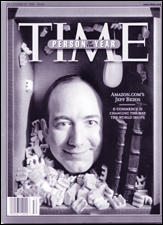
  10. Jeff Bezos is named Time's Person of the Year in 1999. Congrats. He left DE Shaw in 1994 and he's still going strong at AMZN.

Got other good memories of the Bubble? We'd like to hear them below....

Sphere: Related Content

Sunday, October 01, 2006

The Predictors of Significant VC-Backed Firms' Sales Growth


What levers can be pulled to ensure that every start-up from founding is going to achieve significant and sustainable sales growth? If every Venture Capital firm General Partner knew the exact answer to that question, they likely wouldn't be reading this, but joining Sergey Brin and Larry Page (Google founders) in the hot tub (see photo to the left).

Of course, ask 10 different people that question, on the keys to start-up success, and you're likely to get 10 different answers. But empirical proof is always more convincing than speculation.

With this in mind, two years ago, my consulting company began a collaboration with Dartmouth Tuck School Professor Sydney Finkelstein to build a diagnostic that could help predict (1) warning signs that an organization was veering in a direction that might result in major -- and potentially dire -- problems and (2) positive signs that an organization had its leadership, strategy, and processes lined up in a direction that would likely generate consistent and significant sales growth for years to come.

The first of those two goals came out of research conducted over 6 years in the writing of Syd's best-seller 'Why Smart Executives Fail'; and the second came out of research done in the last 3 years contributing in part to Syd's upcoming 'Breakout Strategy.'

The diagnostic (which we call the Breakout Performance Index or BPI) has now been used with over 150 organizations in North America, Europe, Asia, and Australia ranging from multinationals to early-stage venture-backed firms. The three major categories of leadership, strategy, and process, which we measured, were all found to be major predictors of increased revenues and increased market share across the entire dataset.

However, not surprisingly, there were differences across industries (and sometimes countries) in terms of which aspects of our 3 main categories predicted performance. One of the contexts which we have had the opportunity to study in some level of detail is the world of venture-backed firms. Later on this week, Syd will present the results of a recent study we completed on what we found to drive success in venture-backed companies at the Financial Services and Venture Capital Alliance Annual Meeting in Boston.

In the VC context, we studied about 30 companies (asking VCs who serve as directors on companies in which they invest, as well as Management Team members -- mostly the CEOs -- from VC-backed firms to complete the 75 question diagnostic). On average, the companies were 6 years old, had raised about $15MM in VC funding, had 50 employees, were doing about $10MM in annual revenues, with a 15 - 20% annual growth rate, and were just about break-even. Two of the companies in the dataset have recently been acquired (by Cisco and Alcatel) and one has gone out of business.

For those of you who cannot attend Syd's talk in Boston: here are the main results of our study.

  1. How Much Venture Capital A Company Raises Does Not Predict How Much it Will Grow. This result is perhaps not surprising to VCs, who understand that likely only 30% of their investments will be significant 'winners.' But it is interesting that making bigger bets do not correlate with bigger outcomes.
  2. 17 out of our 75 Questions (or about 25%) in the Diagnostic were Highly Significant Predictors of Increased Sales Growth for VC-Backed Firms. The difference between scoring at the median level in a particular dimension versus the top quartile often meant a difference in annual sales growth of 20% versus 100%.
  3. The most important factors relating to Leadership found to predict faster sales growth were: Doing Annual Performance Reviews, Preventing Groupthink on the Management Team, Having a Spirit of Personal Accountability and a "Stakeholders' Mentality," and Key Management Team Structural and Process aspects (like attention to details).
  4. The most important factors relating to Strategy found to predict faster sales growth were: Focusing on the Right Metrics to Measure Implementation of the Company's Strategy and Having a Compensation Plan for Management Team members aligned with the Strategy.
  5. The most important factors relating to Process found to predict faster sales growth were: Having the Correct Organizational Structure in place, Ensuring that the Communication Channels within the organization allowed information to swiftly and correctly travel from the front-lines to the Management Team, and having a Strongly Motivated and Engaged group of Employees.

There are a number of take-aways from this study. The fact that such a high number of questions in the overall diagnostic predicted much faster sales growth is interesting -- and stands out compared to larger companies. VCs are fond of saying that the quality of management is the most important factor they weigh before making an investment, but this study sheds some light on what are the behaviors which management can exhibit to actually positively influence their company's performance.

If you are a GP, how would your investments do on the categories laid out above relative to their peers? If you are a CEO of a VC-backed firm, do these findings suggest you're encouraging the right behaviors on your Management Team and across the organization?

Ultimately, the most important performance metric for VC-backed firms is sales growth. This is usually what sets the value for the organization if it is later sold or goes public. This study suggests there are clearly some levers which you can influence to up your company's growth rate.

If you would like more details on the study or to find out if your firm would rank top quartile or bottom quartile on these dimensions relative to other VC-backed firms, drop me a line.

Sphere: Related Content

Tuesday, September 26, 2006

What Best-In-Class Companies Do To Grow Leaders


There have been numerous Fortune, Forbes, and BusinessWeek stories in the last year citing the importance of growing leaders and the challenges organizations are facing with the coming paucity of leaders due to the demographic shift occuring with the baby boomers retiring and leaving a void.

Paul Reilly of the venerable Korn/Ferry states in the Forbes article linked to above that over 50% of all C-level execs will retire in the next 5 years.

That begs the question: what are organizations doing now to prepare for this difficult challenge? In every crisis, lies opportunity. And, certainly, this immovable fact is good news for the Korn/Ferry's, Monster's, Jobster's, and Recruiting.com's of the world, as it suggests an increasing need from Corporate America for recruiting top talent.

However, the best organizations do not over-rely on recruiting firms to "fix" their lack-of-leadership problem. They look inside and set up processes and programs which ensure that their "Leadership Funnel" is as full as their "sales funnel."

Of course, everyone pays homage to GE, when talking about leadership development. Yet, very few actually do a great job to coach, mentor, and develop top talent.

Here are some quick tips, based on our work with different organizations, on what the best companies do to ensure an adequate supply of leaders for years to come:

  1. Leadership Development happens at multiple levels within the Organization - Not just below the C-Level. We all like short cuts. Yet, we know that, in important areas, we can't take short cuts. Developing an adequate supply of leaders is a long-term investment. The best companies understand that and work at bringing their people along no matter the level of the organization -- from entry-level to the C-Suite.
  2. Assess Where Leaders Are At Today, to Measure Where they will be Tomorrow. You can't improve something, if you don't measure it. Doing a leadership assessment at the front-end of any development program gives you a baseline to measure someone's development -- and hold them accountable if they don't develop. 360s are great as a tool, but the most reliable measurement of a leader's strengths and weaknesses comes from a process called an "Assessment Center" which uses multiple methods (including case studies, work simulations, and behavior-based interviews) to measure someone's leadership performance and potential. One thing that surprised me when I started to "coach" "high-potential" leaders is how many of them were hungry to know where they ranked relative to other leaders out there. Most people work for one company for a long time - sometimes 10, 15, or 20 years. They lose sight of their "market value" relative to other execs. Being able to tell them that they are in the top quartile on "strategic orientation" relative to others is very interesting to them; often raising their confidence levels. By contrast, it can be an eye-opener when they are in the bottom quartile on a number of important leadership dimensions.
  3. Meet with your Boss to discuss the Results of the Assessment and Build an Action Plan. Leadership Development programs fail if the leader's boss is not involved. It's critical to meet with the boss to discuss the strengths and weaknesses that were identified in the assessment. The leader is always interested to have the opportunity to hear how his/her boss sees his/her strengths and weaknesses. This meeting also needs to focus on building a Leadership Development Plan, which the leader and boss buy-in to and endorse.
  4. Track the Leadership Development Action Plan over time. What good is a plan if you don't track it and do what you say you will do. The process of setting up and tracking this action plan forms the basis of the "Leadership Development Program" that the best-in-class companies follow. This program is separate from any performance review process. It is a supplement to that -- not a replacement. In our work, we act as external coaches who come in and meet with the leader once a quarter to review progress over time (usually 2 years). The leader's boss is kept in the loop by receiving updates of the plan on a quarterly basis and then coming back at the 1-year mark and 2-year marks to meet with the leader and external coach. Knowing that you are accountable for progress is a huge stimulant to the leader.
  5. Encourage mentors in your Organization - but don't force them. Mentors are great. Who hasn't had someone take an interest in us at one point in our lives and give us some advice which was really valuable. Yet, a lot of organizations have tried to "assign" mentors to "high-potentials," as part of their leadership development programs. This just doesn't work. It's like fixing up two people on a blind date who have nothing in common or are too busy to meet. The best approach we see is to have the leader and boss discuss some possible mentors (a lot of times the boss will have the best ideas because he/she knows a wider universe of people in the organization who might be interested and a good fit with the leader). Then, the boss should contact the possible mentor, rather than the leader. We've seen successful mentor relationships where the 2 people meet once a year for dinner; others where they meet every couple of months. It's up to the two people. When it works, mentors can have a dramatic impact on "high-potential" leaders.
  6. Discuss Career Path. Many bosses don't make time to sit down and discuss a "high-potential" leader's future career path at that company. However, the ones that do can create tremendous loyalty. People appreciate it (even highly talented people who you might think get tired of all the acclaim they receive) when their boss closes the door and says "let's talk about what you want to accomplish here and how I can help." Ideally, this career vision gets tied into the Leadership Development Plan.

Leadership Development is tough. If it wasn't, we wouldn't be having a "crisis." Recruiting is an answer to a short-term need, but it doesn't address the underlying problem. The best organizations understand that -- buying into it whole-heartedly -- and build systematic processes to ensure their best people know where they need to develop and what their future career path looks like at that company.

Sphere: Related Content

Saturday, September 23, 2006

Before you Pull the Rip Cord: Top Ten Reasons Why It's (Usually) Better for Top Talent to Stay at Larger Companies


After my last post discussing the Top Ten Reasons Why Top Talent Leaves Larger Companies (here if you missed it), several people commented that this was a helpful list which top talent could use as a "litmus test" to decide whether or not to pull the rip cord.

While this is true, I thought it was important to present the other side of the equation before all the highly talented people out there decided to jump ship from Microsoft, Dell, HP, and all the big consulting companies to join the next YouTube, MySpace, etc. The fact is that most highly talented people can get more done as part of a larger organization (with all its imperfections) than at a start-up. This is not a universal statement. Obviously, there are loads of examples where the "best-of-the-best" couldn't take being tethered down in a large bureaucracy, broke away, and -- indeed -- changed the world. Bless the entrepreneurs of the world (I happen to be one too). However, to be fair, before you tender your resignation, please review the following list of reasons why you might be better off where you are:

  1. Picking the next YouTube to join is Tough. If it wasn't, life would be pretty good for the VCs. They would be raking in the returns. Now, despite a previous post of mine in which I expressed a concern that not all people working at VC firms (especially at the junior levels) add tremendous value to their portfolio companies, the fact is that there are some pretty smart GPs out there at VC firms. And yet -- even these veterans of many a start-up occasionally make bad calls. The start-up thing is tough. Are you sure that you're going to be any smarter? Entrepreneurs are inherently optimistic (and, I'll say it again: thank God for that), which makes them not always the best judge. Here's a cautionary tale: George Sheehan left Andersen Consulting (Accenture) at the peak of his career to steer Webvan to a horrible and notorious death. Despite a brief sojourn with Siebel, his career has never recovered and likely never will.
  2. More Money may bring More Problems, but it's still More Money. Large companies, by definition, have more money to throw at new technologies or solving problems. Of course, they don't always do it wisely and there are many an example of them failing to recognize a trend that a smaller competitor capitalizes on. However, you are "top talent." If you figure out what you think your company should be doing, you should be able to persuade the key decision-makers to give you the money and to go out there and get it right. Although Microsoft hasn't always succeeded where it's thrown money at problems, look at what they've done with XBOX. Congrats to Robbie Bach.
  3. First-Mover is not as important as Fast-Follower. Incumbents -- with their money and talent -- can usually take a body-blow and come back much stronger. If you're a talented person working at Google a year ago and you were asked to beef up Google Video vis-a-vis YouTube, what an opportunity. That's what Jennifer Feikin got. And, she's making the most of it. Will it be a challenge to catch YouTube? Sure. But, there's nothing top talent likes more than challenge.
  4. If your boss sucks, you can usually move to a different area. A terrible boss is a killer for most highly talented people, no question. More people quit for this reason more than any other, in my experience. When you talk to them off-the-record afterwards, they describe the past few months as "soul-crushing" and other equally dire terms. However, the good thing about large companies is that you can usually arrange to move to a different area far away from the boss who is driving you nuts. I realize that, if the organization tolerates having this terrible boss, it says a lot about the organization -- and you might not want to be in a different part. But, these days, with a tight supply of talent and a big tent of people filling slots, you might want to not give up on a good thing with the company just because of one person.
  5. The People Who are Most Admired in Business Have Put Down Roots. I have a good friend of mine who has worked for 10 different companies in the last 12 years. Each time, I think he's moved up slightly on the pay-scale and with a little more responsibility and probably a better title. Many people have told me they think he's brilliant. These days, they say to me, you can't be loyal to your company and you need to look out for yourself. I just don't agree. Look at any list of the most admired business people and what do they all have in common: they've all put down roots and transformed that organization. Sometimes it's been a company they started (e.g., Bill Gates) and sometimes not (e.g., Jack Welch). I've yet to see a "career flipper" make the list.
  6. The Start-Up Thing is Tough. At my last company, VoiceGenie, I had the honor of being employee #20 and raising 2 rounds of VC money and building partnerships as VP of Strategy & BusDev. I remember we used to relish the start-up/outsider/raise the pirate flag over our crumby office mentality. And, it was great, learned a lot, and we were ultimately successful -- but it was tough. I'll get together with my former co-workers every now and then and one of us usually says, "I don't know if I could do it again, if you told me I had to go back and do that over." We competed against some great companies like Tellme and BeVocal. I think it's fair to say that everyone working in our industry thought we'd be acquired by late 2001. I still know many fabulous people grinding it out at Tellme and BeVocal and others. And, to them, I say congrats and see point #5 above. However, to everyone else thinking of leaving a big company, I say: you've got to be prepared to go in and grind it out for potentially many years. If you want that, great. However, changing the world in a big company might start looking a little more attractive.
  7. It's easier to find other Top Talent in Large Companies. This is another function of bigger numbers: you're bound to have other smart people that are fun to work with in bigger companies than small. Remember: top talent loves being with other top talent.
  8. Frustrating Bureaucracy can be Fixed. It's not fate that every large company has to have maddening bureaucracy. Hopefully, yours doesn't. If it does, the good news is that it can be fixed. Perhaps you're the person to do. Top talent never shies away from stepping up to clean a big mess. I've ended up talking a lot about HP in these pages in the last few weeks. Although I do not approve of Carly's leadership style, I think it's fair to say that the pre-Carly HP did suffer from frustrating bureaucracy. It appears that she tried to tackle this, with not much success. Hurd has definitely made strides in this respect.
  9. Make your Destiny. Top talent doesn't -- or shouldn't -- sit back and wait for HR or their boss to come to them to discuss their future career path within the organization. They should always be working off their own personal gameplan. It surprises me that only about 15% of hi-po leaders I work with have a more sketched out version of their careers 5 years from now. It's essential to do this if you haven't. You need to make your own destiny.
  10. You can change the World more. The fact is that top talent will change the world wherever they are, but, if all is right with your large organization, you can change the world faster and easier there. Good luck.

Sphere: Related Content
Sunday, September 17, 2006

Top Ten Reasons Why Large Companies Fail to Keep Their Best Talent


Whether it's a high-profile tech company like Yahoo!, or a more established conglomerate like GE or Home Depot, large companies have a hard time keeping their best and brightest in house. Recently, GigaOM discussed the troubles at Yahoo! with a flat stock price, vested options for some of their best people, and the apparent free flow of VC dollars luring away some of their best people to do the start-up thing again. To staunch the exodus, Yahoo! has tried to establish a brickhouse around their best talent.

Yet, Yahoo!, GE, Home Depot, and other large established companies have a tremendous advantage in retaining their top talent and don't. In our business, we see the good and the bad things that large companies do in relation to talent management. Here's our Top Ten list of what large companies do to lose their top talent (and keep an eye out for a future article on the Top Ten Reasons Why It's Usually Better for Top Talent to Stay at these Companies...):

  1. Big Company Bureaucracy. This is probably the #1 reason we hear after the fact from disenchanted employees. However, it's usually a reason that masks the real reason. No one likes rules that make no sense. But, when top talent is complaining along these lines, it's usually a sign that they didn't feel as if they had a say in these rules. They were simply told to follow along and get with the program. No voice in the process and really talented people say "check please."
  2. Failing to Find a Project for the Talent that Ignites Their Passion. Big companies have many moving parts -- by definition. Therefore, they usually don't have people going around to their best and brightest asking them if they're enjoying their current projects or if they want to work on something new that they're really interested in which would help the company. HR people are usually too busy keeping up with other things to get into this. The bosses are also usually tapped out on time and this becomes a "nice to have" rather than "must have" conversation. However, unless you see it as a "must have," say adios to some of your best people. Top talent isn't driven by money and power, but by the opportunity to be a part of something huge, that will change the world, and for which they are really passionate. Big companies usually never spend the time to figure this out with those people.
  3. Poor Annual Performance Reviews. You would be amazed at how many companies do not do a very effective job at annual performance reviews. Or, if they have them, they are rushed through, with a form quickly filled out and sent off to HR, and back to real work. The impression this leaves with the employee is that my boss -- and, therefore, the company -- isn't really interested in my long-term future here. If you're talented enough, why stay? This one leads into #4....
  4. No Discussion around Career Development. Here's a secret for most bosses: most employees don't know what they'll be doing in 5 years. In our experience, about less than 5% of people could tell you if you asked. However, everyone wants to have a discussion with you about their future. Most bosses never engage with their employees about where they want to go in their careers -- even the top talent. This represents a huge opportunity for you and your organization if you do bring it up. Our best clients have separate annual discussions with their employees -- apart from their annual or bi-annual performance review meetings -- to discuss succession planning or career development. If your best people know that you think there's a path for them going forward, they'll be more likely to hang around.
  5. Shifting Whims/Strategic Priorities. I applaud Yahoo!'s plans to build an incubator or "brickhouse" around their talent, by giving them new exciting projects to work on. The challenge for most organizations is not setting up a strategic priority, like establishing an incubator, but sticking with it a year or two from now. Top talent hates to be "jerked around." If you commit to a project that they will be heading up, you've got to give them enough opportunity to deliver what they've promised.
  6. Lack of Accountability and/or telling them how to do their Jobs. Although you can't "jerk around" top talent, it's a mistake to treat top talent leading a project as "untouchable." We're not saying that you need to get into anyone's business or telling them what to do. However, top talent demands accountability from others and doesn't mind being held accountable for their projects. Therefore, have regular touch points with your best people as they work through their projects. They'll appreciate your insights/observations/suggestions -- as long as they don't spillover into preaching.
  7. Top Talent likes other Top Talent. What are the rest of the people around your top talent like? Many organizations keep some people on the payroll that rationally shouldn't be there. You'll get a litany of rationales explaining why when you ask. "It's too hard to find a replacement for him/her...." "Now's not the time...." However, doing exit interviews with the best people leaving big companies you often hear how they were turned off by some of their former "team mates." If you want to keep your best people, make sure they're surrounded by other great people.
  8. The Missing Vision Thing. This might sound obvious, but is the future of your organization exciting? What strategy are you executing? What is the vision you want this talented person to fulfill? Did they have a say/input into this vision? If the answer is no, there's work to do -- and fast.
  9. Lack of Open-Mindedness. The best people want to share their ideas and have them listened to. However, a lot of companies have a vision/strategy which they are trying to execute against -- and, often find opposing voices to this strategy as an annoyance and a sign that someone's not a "team player." If all the best people are leaving and disagreeing with the strategy, you're left with a bunch of "yes" people saying the same things to each other. You've got to be able to listen to others' points of view -- always incorporating the best parts of these new suggestions.
  10. Who's the Boss? If a few people have recently quit at your company who report to the same boss, it's likely not a coincidence. We'll often get asked to come in and "fix" someone who's a great sales person, engineer, or is a founder, but who is driving everyone around them "nuts." We can try, but unfortunately, executive coaching usually only works 33% of the time in these cases. You're better off trying to find another spot for them in the organization -- or, at the very least, not overseeing your high-potential talent that you want to keep.

It's never a one-way street. Top talent has to assume some responsibility as much as the organization. However, with the scarcity of talent -- which will only increase in the next 5 years -- Smart Organizations are ones who get out in front of these ten things, rather than wait for their people to come to them, asking to implement this list.

Next time, we'll cover the Top Ten Reasons Why It's Usually Better for Top Talent to Stay at Larger Companies... who are hopefully following the advice laid out above.

PS. Thanks to Jason for loan of the image above.

Sphere: Related Content

Friday, September 15, 2006

The Problem at HP Wasn't Dunn, but the Board

HP has been in the news for all the wrong reasons in the past 3 weeks. Our focus has gone away from the impressive rise in its stock price since Mark Hurd's appointment as CEO; as quickly as Dell's stock price and corporate reputation has dropped, HP's has risen.

We've previously spoken out on how Hurd's qualities as a leader have -- in many ways -- been the perfect antidote to the erstwhile Carly regime. And, yet, we've had to endure the titilating but disturbing news of the "pretexting" actions carried out down the line from the board's decision to purge a "leak" from within their midst.

The mainstream press commentary on this whole sorry episode has focused primarily on either (1) the disregard for privacy exhibited by the board's actions, (2) whether Dunn should have left sooner, or (3) the lack of a full apology by the board or Hurd to the events. However, little, if any, attention has been paid to the composition of the HP board itself -- the entire group responsible for the actions that have drawn such criticism.

The fact is that the entire HP board deserves an overhaul after this mess. Nell Minow -- corporate goverance critic -- calls the board "dysfunctional" and she's right.

Here's a quick run-down of the players (from HP's site):

Lawrence T. Babbio, Jr.

Director since 2002Mr. Babbio has served since 2000 as vice chairman and president of Verizon Communications, Inc. (formerly Bell Atlantic Corporation). Mr. Babbio was a director of Compaq from 1995 until its merger with HP in May 2002. Mr. Babbio is also a director of ARAMARK Corporation. In 1997, he was elected president and chief operating officer of Network Group and chairman of Global Wireless Group of Bell Atlantic.

Sari M. Baldauf

Director since 2006Ms. Baldauf served as Executive Vice President and General Manager of the Networks business group of Nokia Corporation ("Nokia"), a communications company, from July 1998 until February 2005. She previously held various positions at Nokia since 1983. Ms. Baldauf also serves as a director at SanomaWSOY, F-Secure, the Savonlinna Opera Festival and on the Global Board of the International Youth Foundation.

Patricia C. Dunn

Director since 1998Ms. Dunn was named non-executive chairman of the board of directors of HP in February 2005. A member of HP's board since 1998, she previously served as chairman of the audit committee. Ms. Dunn was elected vice chairman of Barclays Global Investors (BGI) in 2002 and served as its co-chairman, chairman and chief executive officer from 1995 through 2002. As CEO of BGI, she directed its growth into new global markets for the firm's core investment capabilities and expanding its offerings into new product categories. Ms. Dunn advises on strategy and key business issues for BGI. She joined the firm's predecessor organization, Wells Fargo Investment Advisors, in 1978. She also serves on the advisory board of the UC Berkeley Haas School of Business, as well as the conference board's Center for Corporate Governance, and serves as the director and a member of the executive committee of Larkin Street Youth Services in San Francisco.

Richard A. Hackborn

Director since 1992Mr. Hackborn served as HP's chairman of the board of directors from January 2000 to September 2000. Prior to retiring from HP in 1993 after 33 years of service, he held several top management positions at the company. From 1990 until his retirement, he was responsible for HP's PC and personal information product business. His leadership and design engineer background resulted in the integration of HP's early minicomputer and high-frequency test instrumentation businesses. In 1979, Mr. Hackborn served as general manager and then vice president of the printing business, where he was responsible for the development of key HP printing technologies, such as inkjet and laser printing, and for the design and manufacture of non-impact print technologies.

John H. Hammergren

Director since 2005Mr. Hammergren has served as Chairman of McKesson Corporation since July 2002 and President and Chief Executive Officer since April 2001. From July 1999 to April 2001, Mr. Hammergren served as Co-President and Co- Chief Executive Officer.

Mark V. Hurd

Director since 2005Mr. Hurd became chief executive officer and president of HP, and joined HP’s board of directors, effective April 1, 2005. Mr. Hurd served as chief executive officer of NCR Corp. from March 2003 to March 2005, and as president from July 2001 to March 2005. From September 2002 to March 2003, Mr. Hurd was the chief operating officer of NCR, and from July 2000 until March 2003, he was chief operating officer of NCR’s Teradata data-warehousing division. Mr. Hurd also served as executive vice president of NCR from July 2000 through July 2001.

Robert L. Ryan

Director since 2004Mr. Ryan served as senior vice president and chief financial officer of Medtronic, Inc., a medical technology company, from 1993 until his retirement in May 2005. He is a director of UnitedHealth Group.

Lucille S. Salhany

Director since 2002Ms. Salhany founded JHMedia, a consulting company, and has served as its president and chief executive officer from 1997 to 1999 and again since 2002. Ms. Salhany has consulted for such clients as Macy's, NASA and Chris-Craft Industries. From 1999 to 2002, she was president and chief executive officer of LifeFX Networks, Inc. Ms. Salhany was a director of Compaq from 1997 until its merger with HP in 2002. She is also a director of Boston Restaurant Associates and a trustee of The Hillside School and Emerson College.

Robert P. Wayman

Director since 2005Mr. Wayman has served as chief financial officer of HP since 1984 and as executive vice president since 1992. Mr. Wayman served as interim chief executive officer from February 2005 through March 2005, and re-joined HP's board of directors in February 2005. Mr. Wayman had previously served on HP's board from 1993 to 2002. Mr. Wayman is a director of CNF Inc. and Sybase Inc. He also serves as a member of the Kellogg Advisory Board to the Northwestern University School of Business.

______

Here are some facts about the board today. 33% of the Directors today have career IT/PS experience - 3 of 9. However, all 3 of these people are HP "Insiders" - Hackborn and Wayman used to work for HP and Hurd is, of course, now Chair, CEO, and President. I have nothing against insiders serving on the board, but it would be ideal to have some other points of view on the board from the industry but outside the HP "way." While McKesson, Medtronic, and Verizon are big companies, can the growth strategies from these very different industries be applied within HP's portfolio of industries?

There are 2 former directors from Compaq on HP's board: Ms. Salhany and Mr. Babbio. But, they cannot give industry advice. Being a director is not being an operator and vice-versa; I will trade a boatload of "independent" directors (no matter their pedigree) for a handful of directors who are former operators from successful companies within the same industry any day of the week. The role of directors is to monitor and advise management, but how can you effectively do this if you don't "know" the industry?

And HP is dead wrong to give Mark Hurd the "Chairman" title. Pattie Dunn correctly was dismissed for her role in the scandal, but she served an important role on this board as a "non-executive chair." HP sought to provide a counter-balance to Hurd's new power on the board with his additional title by naming Dick Hackborn as "designated lead independent director."

Dick has been a director with HP since 1992. However, he was the strongest voice who pushed the board to appoint Carly Fiorina as CEO in late 1998. George Anders chronicles Hackborn's choice of Carly in his 2003 book "The Carly Chronicles." Here's a particularly interesting passage from Fast Company:

...Fiorina emerged as one of four finalists for the job. The crucial interview would be with Richard Hackborn, a key director and retired HP executive who had built the company's enormously successful printer business. They met at Chicago's O'Hare Airport, at a restaurant decorated like an imitation speak-easy. Within minutes, they were talking about HP more bluntly and more affectionately than either had expected.

Hackborn guided Fiorina through HP's business challenges that needed fixing: The personal-computing division was acting as if fast-charging rival Dell Computer Corp. didn't exist. The sales force was tripping over itself. The company was losing ground to younger rivals, such as Dell, Lexmark, and Sun Microsystems, which irked Hackborn greatly. "We're in danger of losing everything that made this company great," he said. Fiorina listened carefully and explained her work at Lucent, where she had built an industry-leading sales force. She had come to the lunch regarding Hackborn as the company's Yoda: the elder figure of supreme respect and the true decision maker in the search for HP's new CEO.

Several hours into the meeting, Fiorina began speculating about who should be chairman if she became CEO. She wanted some wise-uncle support early on. Departing CEO Platt had signaled his desire to remain chairman, and she thought he could help. But she quickly realized that Hackborn didn't like that idea. At that moment, an idea popped into her mind. Looking at Hackborn, other people might have seen a wrinkled retiree with sunken eyes and white hair. She saw something different: a special counselor. Rather than get tangled up in a Platt conversation, she looked at Hackborn and said, "Actually, Dick, I think you ought to be chairman."

The idea startled Hackborn. He had been seeking to wind down his commitments to HP. But as he and Fiorina continued talking, he warmed to the idea. When their meeting ended and Fiorina headed toward her plane, she told herself, "I've got him hooked!"

Soon afterward, Hackborn briefed the entire HP board on his chat with Fiorina. "I could see he was dazzled by her," fellow director Patricia C. Dunn recalls. "He was really excited about her vision for the company. She had a feel for the company's strengths and weaknesses. It corresponded with his feel." Hackborn expressed mild concern about Fiorina's lack of a technical background, but that wasn't a top-priority worry for him. "We may be getting one of the top two or three CEOs of our generation," Hackborn declared. "She could be the next Jack Welch."

And, so it goes. Carly's gone, Tom Perkins is gone, George Keyworth is gone, Pattie's going (in January), Mark's getting a promotion, and Dick will assume an elevated role within the board. Would this board still be in tact if HPQ's stock had not jumped 75% since the dawn of Hurd? It doesn't deserve to be, no matter the current success the organization is enjoying. HP's shareholders deserve better.

On the day it was announced that the board would be reshuffled, Tom Perkins -- who has been a strong voice in the HP boardroom, up until he resigned over the "pretexting" earlier this year -- said: "This too shall pass." Alas, Tom, I fear it will; and, in 5 years, HP's board will not be all that different from how it looks today.

Sphere: Related Content

Monday, September 11, 2006

It's All About Me

For those of you who asked, here is a link to the previously mentioned, often discussed, but not so commonly read paper by Chatterjee and Hambrick: http://jacksonleadership.com/pdfs/Narcissistic_CEOs_05-04-06_ASQ.pdf .

Many thanks to Don for so promptly sending it me to share with the Breakout Performance community.

The title says it all: "It's All About Me: Narcissistic CEOs and Their Effects on Company Strategy and Performance." It's been recently submitted for publication in Administrative Science Quarterly.

Sphere: Related Content

Sunday, September 10, 2006

Narcissistic CEOs

My doctoral advisor from a few years back, Don Hambrick, has -- it seems -- struck a nerve with some new research. With Arijit Chatterjee -- a doctoral student at Penn State University -- Don has written a new working paper (I don't believe it's been published yet) titled: It’s All About Me: Narcissistic CEOs and Their Effects on Company Strategy and Performance . Don always has had a gift for naming phenomena with colorful words and picking great paper titles.

I went on Don's and Arijit's websites to try and download the paper to read myself with no luck. However, Don was kind enough to send me a copy. To read it, go here. However, in the blogosphere, reading the actual paper before commenting is not required. At least one person read the paper (I hope): Francesco Guerrera in the Financial Times in an article a few weeks back titled "Forget the salary packages, look at the size of their egos." (For more coverage, see the Forbes article here, and the Economist's take here.)

The authors counted the number of times a CEO used the word "I" in their annual letters to shareholders; they looked at the length of their entries for their "Who's Who" bios; and they looked at the size of their photos in the annual reports. (You have to give Don and Arijit a 10 on originality for their measures.) All 3 positively predicted that these CEOs would take larger strategic risks. Risks can be successful and also not so successful. The point of the research is that bigger egos take bigger risks.

The comments in the blogs have been more negative than positive. Leslie Gaines-Ross called it "CEO Bashing." Richard Edelman also chides the professors and moreso the FT editor for urging CEOs to be bashful. He (and Ms. Gaines-Ross) are essentially saying that CEOs should always swing for the fences -- else, what great things would be accomplished in this world? Ian Griffin is more encouraging of the advice that CEOs should be wary of letting their egos get outsized. He offers up the CEO of BASF, Jurgen Hambrecht, as a better model of a CEO; more "conductor," less "rock star."

I think the flaw in the criticisms is that they equate the suggestion/advice of reigning in the egos as being tantamount to taking no risks. After all, who wants a Churchmouse CEO? I believe Don would be the first to say all CEOs must take risks. That's what they're hired to do: review alternatives and make strategic choices. Every choice or non-choice is a decision and risk. However, you can take risks with a sense of humility. It's the organization and team driving it that is the star -- not you. What's more, Don's research here, as well as research done by his proteges Syd Finkelstein and me have shown that "authentic" (read: humble and easy for others in the organization to relate to) leaders' organizations are more successful (with much less risk of failure) than "celebrity" leaders' organizations.

For every Carly, there will be a Mark Hurd to point to; for every Steve Jobs and Richard Branson (cowboys who went out and created empires), there will be a Michael Eisner and Al Dunlap. Take risks, change the world, but keep eating your lunch in the company cafeteria.

Sphere: Related Content

Sunday, September 03, 2006

Carly's Biggest Shortcoming


Carly Fiorina has taken her lumps. The former head of HP was once touted as the most powerful woman in US business -- and perhaps the world. She was pried loose from Lucent -- back when Lucent was a high-flier, pre-bubble -- to take over HP, at the time, seen as a lumbering Giant in need of some "new economy" fairy dust. She brought glitz, she brought ink, and (see the attached photo) she even brought a little celebrity (that's Gwen Stefani helping make HP digital cameras cool), but in the end her tenure can only be marked as an ignominious failure.

There are many lessons to be leared from her time at HP. However, the most important one is the Power of "Authentic Leadership."

One of the most critical aspects we have found in our research linked to long-term increase in shareholder value is a CEO who embodies "authentic leadership." That is, the people who actually make the organization successful -- often far away from the executive suite -- can relate to their leader(s). With Carly, from Day One, there was a gulf. Whether intentional or not on her part, she oozed self-importance. From her Hilary Clinton-esque wide lapels and power suits to the way she walked the stage at all the big trade shows with her flashy head-mic, you wouldn't expect to run into her at the Mountain View Starbucks. She had the air that she was always running late to meet some head of state or speak at Davos -- as opposed to running the business. This bred enormous disenchantment with the HP employees and - ultimately- the board of directors.

No executive or CEO fails alone. There is blame to be shared -- just as credit should also go to others in times of success. The board is the one who hired Carly; and they made the final decision to let her go. They surely forgot about the importance of "Authentic Leadership" at the time of hiring. Going back to then, they wanted to get a little bit of sizzle into HP's stock; and who couldn't have been impressed by Lucent's success to that point? Carly was able and more than accomplished looking over her CV to that point. How many people, in retrospect of a bad hire, have later said: "He/She looked so good on paper"?

They forgot to delve into whether "authentic leadership" was an issue for Carly. But they didn't when it came time to choose her successor. Mark Hurd is something of an anti-Carly. Quiet, unassuming, from Dayton! He's not the star -- it's the organization, which is to say the employees. I talked to some HP employees a few weeks ago and their relief under the new regime is palpable.

For execs and board members, the message is clear: CEOs better be able to connect with their people, or they won't stay connected to their board.

Sphere: Related Content